Here’s a number that might surprise you: most adults in the UK get around 18g of fibre a day. The NHS recommends 30g. That’s a 12g gap — and it adds up. Not just in terms of digestion, but in energy, gut health, blood sugar balance, and how satisfied you feel after meals. The good news? Closing that gap is genuinely simpler than you’d think. You don’t need to overhaul your diet. You just need to know where fibre hides — and a few smart ways to get more of it into what you’re already eating.
Why 30g? What Fibre Actually Does
Fibre tends to get boxed into one conversation: digestion. And yes, it absolutely supports regularity. But that’s a fraction of what it does for your body.
Fibre slows things down in the right way. Soluble fibre forms a gel-like substance in your gut that slows the absorption of sugar into your bloodstream. That means steadier energy, fewer crashes, and less of that 3pm slump that sends you reaching for something sweet.
It feeds your gut bacteria. Your microbiome — the trillions of bacteria living in your digestive system — relies on fibre as its primary food source. When those bacteria ferment fibre, they produce short-chain fatty acids that nourish the cells lining your gut, reduce inflammation, and support your immune system. A well-fed microbiome shows up in your digestion, your skin, and your overall energy.
It helps you feel full, naturally. High-fibre meals take longer to eat and longer to digest, which means you feel satisfied for longer without needing to eat more. It’s not about restriction — it’s about your body having what it needs to regulate appetite on its own.
It supports heart health. Soluble fibre binds to cholesterol in your digestive system and helps carry it out of your body. Over time, a consistently high-fibre diet can contribute to healthier cholesterol levels — quietly, without drama.
So when the NHS says 30g, it’s not an arbitrary number. It’s the threshold where these benefits start adding up in a meaningful way. And 18g — where most of us currently sit — simply isn’t enough to get the full picture.
A Sample Day: Hitting 30g With Real UK Foods
This is where it gets practical. Forget exotic superfoods or complicated meal plans. Here’s what a 30g fibre day actually looks like using foods you’ll find in any UK supermarket.
Breakfast (8-10g)
Option A: Porridge made with 40g oats (4g) + a sliced banana (2.5g) + a tablespoon of chia seeds (3.5g) = roughly 10g of fibre before you’ve left the house.
Option B: Two Weetabix (3.8g) + a handful of berries (2g) + a slice of wholemeal toast (2.5g) = roughly 8.3g.
Both are high-fibre breakfasts that take minutes to prepare. The key is choosing whole grains as your base and adding fruit or seeds on top.
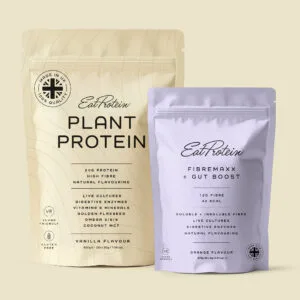
Want an easy boost? Add a scoop of EatProtein Prebiotic Fibre to your morning smoothie or stir it into your porridge. It’s tasteless, dissolves in seconds, and adds prebiotic fibre from chicory root inulin — feeding your gut bacteria while topping up your daily total.
Lunch (8-10g)
Option A: A wholemeal wrap (3g) filled with mixed beans (6g) and salad veg (2g) = roughly 11g.
Option B: A bowl of lentil soup (5g) with a wholemeal bread roll (3g) and an apple on the side (2g) = roughly 10g.
Beans and lentils are fibre powerhouses — and they’re inexpensive, versatile, and available everywhere. If you’re not already adding pulses to your lunches, this is the single easiest change you can make.
Dinner (8-10g)
Option A: Chickpea curry (6g) with brown rice (3g) and a side of broccoli (3g) = roughly 12g.
Option B: Wholemeal pasta (5g) with mixed vegetables (3g) and a side salad (2g) = roughly 10g.
The pattern here is simple: swap refined grains for whole grains, and make sure there’s a portion of vegetables or pulses alongside your protein.
Snacks (4-6g)
Option A: A handful of almonds (2g) + a pear (3.5g) = roughly 5.5g.
Option B: Hummus with carrot sticks (3g) + a couple of oatcakes (2g) = roughly 5g.
Daily total: 30-35g. No supplements required — though they certainly help on days when meals don’t go to plan.
15 High-Fibre Foods: Your Cheat Sheet
Keep this list on your phone the next time you’re doing a shop. These are all common UK foods with their fibre content per serving — nothing obscure, nothing expensive.
- Black beans (80g cooked): 6g
- Baked beans (half a tin): 5g
- Avocado (half): 5g
- Wholemeal pasta (75g dry): 5g
- Lentils (80g cooked): 4g
- Chickpeas (80g cooked): 4g
- Sweet potato (1 medium, skin on): 4g
- Oats (40g): 4g
- Chia seeds (1 tablespoon): 3.5g
- Pear (1 medium): 3.5g
- Popcorn (30g): 3.5g
- Broccoli (80g): 3g
- Raspberries (80g): 3g
- Wholemeal bread (1 slice): 2.5g
- Banana (1 medium): 2.5g
- Almonds (30g): 2g
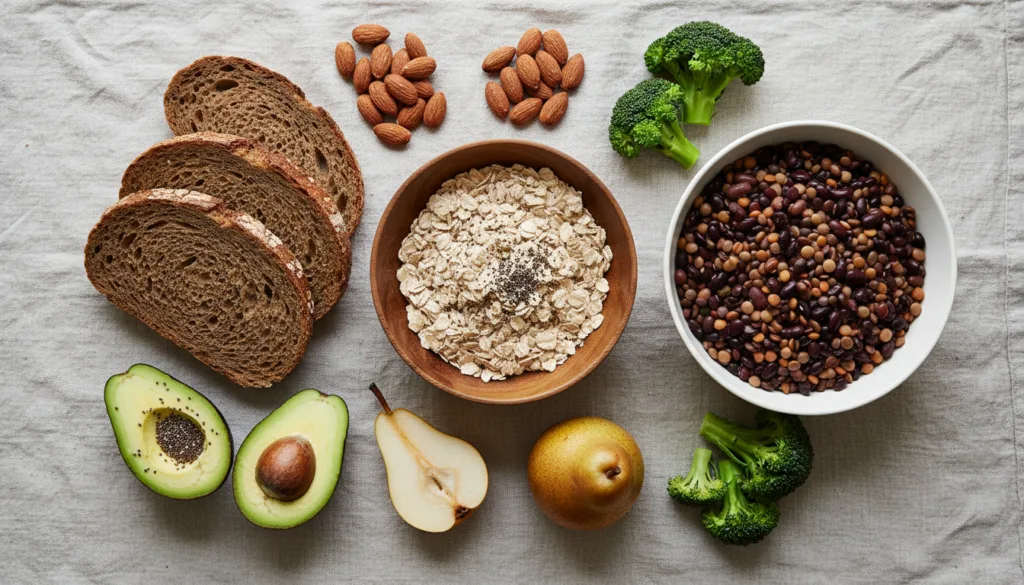
Notice the pattern: pulses, whole grains, fruits, vegetables, nuts, and seeds. The foods with the most fibre are the ones that haven’t been heavily processed. The closer something is to how it grew, the more fibre it tends to have.
Easy Swaps That Add Up
You don’t need to rebuild your meals from scratch. Sometimes, swapping one ingredient for another adds several grams of fibre without changing how the meal tastes or how long it takes to prepare.
- White bread to wholemeal — adds roughly 1.5g per slice. Over two slices of toast or a sandwich, that’s 3g extra.
- White rice to brown rice — adds roughly 2g per serving. Same meal, just a different grain.
- White pasta to wholemeal pasta — adds roughly 3g per serving. One of the biggest single swaps you can make.
- Crisps to popcorn — adds roughly 2g per serving. And popcorn is a whole grain, which most people don’t realise.
- Fruit juice to whole fruit — adds 2-3g. Juicing strips out the fibre and leaves the sugar. Eating the whole fruit gives you both.
- Cornflakes to porridge oats — adds roughly 3g. A bowl of porridge is one of the simplest high-fibre breakfasts going.
None of these swaps are dramatic. None of them require you to eat something you don’t enjoy. But collectively, across a day, they can add 10g or more to your fibre total — and that’s the difference between falling short and hitting your target.
High-Fibre Snacks Worth Knowing About
Snacking is where a lot of fibre gets left on the table. Crisps, biscuits, and chocolate bars contribute almost nothing. But a few smart choices between meals can add 4-6g to your day without much effort.
- Hummus with veggie sticks — carrot, cucumber, celery, and pepper sticks dipped in hummus. Satisfying, portable, and fibre-rich from both the chickpea base and the raw veg.
- A handful of almonds or mixed nuts — almonds are the highest-fibre nut at around 2g per 30g serving. Cashews and walnuts add a gram or two as well.
- Apple or pear with nut butter — the fruit delivers fibre, the nut butter delivers healthy fats, and together they keep you going until your next meal.
- Oatcakes with avocado — whole grain oatcakes topped with mashed avocado. Simple, filling, and adds 4-5g of fibre in just a few bites.
- Popcorn — genuinely one of the best high-fibre snacks available. Air-popped or lightly seasoned, a 30g serving gives you 3.5g of fibre from whole grain maize. Far better than crisps.
- Trail mix with dried fruit and seeds — a mix of almonds, pumpkin seeds, raisins, and dried apricots makes a snack that travels well and adds both fibre and nutrients.
The trick is keeping these options accessible. If they’re in your cupboard or your bag, you’ll reach for them. If they’re not, you’ll default to whatever’s easiest — and easiest rarely means fibre-rich.
Where Fibre Supplements Fit In
Let’s be honest: some days, you’re not going to hit 30g from food alone. Maybe lunch was a quick sandwich on white bread. Maybe dinner was a takeaway. Maybe you just didn’t have the time or energy to think about fibre content while feeding the family. That’s normal — and that’s exactly where a fibre supplement earns its place.
A prebiotic fibre supplement isn’t a replacement for high-fibre foods. It’s a safety net. On good days, it tops up your total. On busy days, it closes the gap. Either way, you’re giving your body more of what it needs.
Prebiotic fibre — like chicory root inulin — does double duty. It adds to your daily fibre count and selectively feeds the beneficial bacteria in your gut. That’s the distinction between a prebiotic fibre and any generic bulking agent. You’re not just adding volume — you’re actively supporting your microbiome.
Chicory root inulin is one of the most researched prebiotic fibres available. It dissolves easily in water, smoothies, porridge, or tea without changing the taste. A single scoop added to your morning routine can contribute several grams of fibre — enough to bridge the gap between a decent diet and a genuinely high-fibre one.
If you’re interested in the broader picture of how prebiotics and probiotics work together, it’s worth understanding that feeding your existing gut bacteria (prebiotics) is just as important as introducing new ones (probiotics). They’re complementary — and fibre is the foundation.
EatProtein’s Prebiotic Fibre is made from chicory root inulin — a clean, plant-based prebiotic that feeds your gut bacteria while adding to your daily fibre total. No artificial sweeteners, no fillers, made in the UK. It stirs into anything, tastes of nothing, and quietly does its job.
Tips for Increasing Fibre Without the Bloat
If you’ve ever tried to eat healthier overnight and ended up feeling worse for the first few days, you’re not alone. A sudden jump in fibre intake can cause bloating, gas, and discomfort — not because fibre is bad for you, but because your gut bacteria need time to adjust to the increased workload.
Here’s how to increase your fibre intake comfortably:
- Go gradually. Add 3-5g extra per day rather than jumping from 18g to 30g overnight. Give your gut a week to adjust at each stage before adding more.
- Drink plenty of water. Fibre absorbs water as it moves through your digestive system. Without enough fluid, it can slow things down rather than speed them up. Aim for 6-8 glasses a day — more if you’re active.
- Give your gut time. Initial bloating usually settles within one to two weeks as your gut bacteria adapt to the higher fibre load. It’s a sign that things are working, not a sign that something’s wrong.
- Choose prebiotic fibre. Not all fibre supplements are the same. Prebiotic fibres like chicory root inulin tend to be gentler than some bulking fibres, and they come with the added benefit of supporting your gut bacteria directly.
- Spread it across the day. Rather than loading all your fibre into one meal, distribute it across breakfast, lunch, dinner, and snacks. Your gut handles a steady supply better than a single large dose.
If you’re someone who’s had digestive sensitivities in the past, start even more slowly and listen to your body. There’s no deadline. The goal is a sustainable, comfortable increase that you can maintain long-term — not a sprint to 30g that leaves you uncomfortable.
For more on the foods that support a healthy gut alongside fibre, our guide to gut health foods covers the wider picture — from fermented foods to prebiotic-rich ingredients.
Close the Gap, Feel the Difference
Thirty grams of fibre a day isn’t an aspirational target. It’s achievable — with porridge, beans, wholemeal bread, fruits, vegetables, and a few thoughtful swaps. Most of us are already eating some of these foods. It’s just a matter of choosing them more often, more consistently, and knowing where those extra grams come from.
On the days when food alone doesn’t get you there, a prebiotic fibre supplement can close the gap — simply, without fuss, and with the added benefit of supporting the bacteria that keep your gut healthy.
Your gut does a remarkable amount for you. Giving it 30g of fibre a day is one of the easiest, most impactful things you can give it back.
Ready to top up your daily fibre? Explore EatProtein’s Prebiotic Fibre range — clean, plant-based, and designed to support your gut from the inside out. Or pair it with our Vegan Protein, which includes prebiotic fibre from chicory root inulin alongside live cultures and digestive enzymes.
References
- NHS. (2022). How to get more fibre into your diet. NHS.uk. View source
- Scientific Advisory Committee on Nutrition (SACN). (2015). Carbohydrates and Health. Public Health England. View source
- Public Health England. (2019). National Diet and Nutrition Survey: Years 9 to 11 of the Rolling Programme (2016/2017 to 2018/2019). View source
- British Dietetic Association. (2021). Fibre Food Fact Sheet. BDA. View source
- Dahl, W.J., & Stewart, M.L. (2015). Position of the Academy of Nutrition and Dietetics: health implications of dietary fiber. Journal of the Academy of Nutrition and Dietetics, 115(11):1861–1870. View source
- Threapleton, D.E., Greenwood, D.C., Evans, C.E., et al. (2013). Dietary fibre intake and risk of cardiovascular disease: systematic review and meta-analysis. BMJ, 347:f6879. View source
- Dahl, W.J., Zank, L., & Auger, J. (2017). Effect of consumption of chicory inulin on bowel function in healthy subjects with constipation. International Journal of Food Sciences and Nutrition. View source