Prebiotics, probiotics, synbiotics, digestive enzymes — they all sound important, but what do they actually do? And which ones are right for you? This guide breaks it all down clearly, so you can choose with confidence and start supporting your gut in a way that genuinely works.
Why Gut Health Supplements Matter
Your gut microbiome — the trillions of bacteria living in your digestive system — influences far more than digestion. It plays a role in your immune function, your mood, your energy levels, and even the health of your skin. When your microbiome is thriving, you tend to feel it everywhere.
The challenge is that modern life doesn’t always make it easy to keep your gut in great shape. Most adults in the UK fall short of the recommended 30g of daily fibre, and that gap means your beneficial bacteria aren’t always getting the fuel they need. A well-chosen gut health supplement can help bridge that gap — working alongside a balanced, fibre-rich diet to give your microbiome the consistent support it thrives on.
That said, supplements are exactly that — supplementary. They work best as part of a wider approach that includes whole foods, hydration, and daily movement. Think of them as a reliable daily boost for a gut you’re already looking after.
The Main Types of Gut Health Supplements
Before you choose a supplement, it helps to understand what’s out there and how each type works. Gut health supplements fall into a few clear categories, and knowing the difference will help you find the right fit for your body.
Prebiotics
Prebiotic supplements provide the specific types of fibre that feed the beneficial bacteria already living in your gut. They don’t introduce new bacteria — instead, they nourish the good strains you already have, helping them grow and outnumber the less helpful ones.
The most well-researched prebiotic is chicory root inulin — a naturally sourced soluble fibre that travels through your digestive system intact until it reaches your large intestine, where your beneficial bacteria ferment it as fuel. This fermentation produces short-chain fatty acids that nourish your gut lining, support your immune system, and help maintain a healthy gut environment.
Other prebiotic ingredients you’ll see in supplements include fructo-oligosaccharides (FOS), galacto-oligosaccharides (GOS), and partially hydrolysed guar gum. Each has its own research base, but chicory root inulin remains one of the most studied and consistently effective.
Best for: anyone looking to support the bacteria they already have, improve regularity, and increase their daily fibre intake in a simple, consistent way.
Probiotics
Probiotic supplements contain live microorganisms — typically specific strains of Lactobacillus, Bifidobacterium, or Saccharomyces — designed to add beneficial bacteria directly to your gut. The idea is to introduce new strains that can take up residence and contribute to a more diverse, resilient microbiome.
The effectiveness of a probiotic depends on the specific strains used, the number of colony-forming units (CFUs), and whether the bacteria can survive your stomach acid to reach your intestines alive. Strain specificity matters — a probiotic formulated for digestive comfort may use entirely different strains than one designed for immune support. Understanding how prebiotics and probiotics differ will help you decide which approach makes the most sense for your goals.
Best for: people looking to increase the diversity of their gut bacteria, those recovering from a course of antibiotics, or anyone wanting targeted support from specific bacterial strains.
Synbiotics
A synbiotic supplement combines prebiotics and probiotics in a single formula — and this is where things get really interesting. The prebiotic fibre acts as fuel for the probiotic bacteria, giving them the best possible chance to establish themselves in your gut. Instead of just introducing new bacteria and hoping for the best, a synbiotic approach feeds them from the moment they arrive.
This combined approach is increasingly supported by research as a more effective way to shift the balance of your microbiome in a positive direction. When the prebiotic and probiotic components are chosen to work together, the whole becomes greater than the sum of its parts.
Best for: anyone who wants comprehensive microbiome support in one step — particularly if you’re looking for both diversity and nourishment for your gut bacteria.
Digestive Enzymes
Digestive enzyme supplements support the mechanical process of breaking food down into nutrients your body can absorb. They contain enzymes like protease (for protein), lipase (for fats), amylase (for carbohydrates), and lactase (for dairy). These enzymes complement the ones your body produces naturally.
If you’ve ever felt heavy or uncomfortable after a meal — that sluggish, too-full feeling — it can sometimes indicate that your body could use a little extra support with digestion. Digestive enzymes work at the front end of the process, helping your body access the nutrition in your food more efficiently. If bloating after eating is something you recognise, enzymes are worth exploring as part of your approach.
Best for: people who experience discomfort after meals, those with specific food sensitivities, or anyone looking to optimise how well they absorb nutrients from their diet.
Fibre Supplements
Fibre supplements overlap with prebiotics, but there’s an important distinction. Prebiotic fibres specifically feed beneficial gut bacteria, while some fibre supplements — like psyllium husk or methylcellulose — focus primarily on adding bulk and supporting regularity. Both are valuable, but if your goal is microbiome support, choosing a fibre with proven prebiotic properties — like chicory root inulin — gives you both the fibre benefits and the bacterial nourishment in one.
Best for: anyone who struggles to reach their daily fibre goals through food alone, or those looking for gentle, consistent digestive support.
What to Look For in a Gut Health Supplement
With so many options available, knowing what makes a quality supplement stand out will help you choose with clarity. Here are the things worth paying attention to.
Well-researched ingredients
The strongest supplements are built on ingredients with a solid body of research behind them. Chicory root inulin, for example, has decades of published clinical studies supporting its prebiotic effects. When a supplement lists its key ingredients, it’s worth checking whether those ingredients have been studied in human trials — not just in lab settings. Look for specificity: named bacterial strains (not just “probiotic blend”), identified fibre sources (not just “dietary fibre”), and clear ingredient origins.
Transparent labelling
A good label tells you exactly what’s inside and in what amounts. Look for supplements that list every ingredient clearly, include the dose per serving, and specify exactly which strains, fibres, or enzymes are included. Thoughtful brands make this information easy to find because they’re proud of what’s in their formula.
A formula that matches your needs
There’s no single “best” gut supplement — the right one depends on what your body needs. If you’re focused on feeding your existing bacteria and boosting your fibre intake, a prebiotic is your starting point. If you want to introduce new strains, a probiotic with well-researched strains makes sense. If you want comprehensive support, a synbiotic approach that combines prebiotics and probiotics gives you the best of both worlds.
Clean formulation
The best supplements keep things simple. Look for formulas that prioritise active ingredients without unnecessary extras — no artificial sweeteners, minimal fillers, and clear sourcing. These details signal a brand that’s paying attention to quality, not just marketing.
Appropriate dosing
More isn’t always better with gut health supplements. Effective prebiotic doses typically start around 3–5g per day, while probiotic needs vary depending on the strains used. A well-formulated supplement provides a meaningful dose in its recommended serving, backed by research on its specific ingredients.
How EatProtein’s Range Supports Your Gut
We designed our range with complete gut support in mind — not as isolated products, but as parts of a system that work beautifully together.
EatProtein’s Prebiotic Fibre is built on chicory root inulin — one of the most researched prebiotic fibres available. It feeds the beneficial bacteria already in your gut, supports digestive regularity, and helps you reach your daily fibre goals. No artificial sweeteners, no unnecessary fillers, made in the UK. Just clean, effective prebiotic support.
If you’re looking for a starting point, our Prebiotic Fibre is it — nourishing your microbiome from the inside out with a single, well-researched ingredient that fits seamlessly into whatever you’re already eating or drinking.
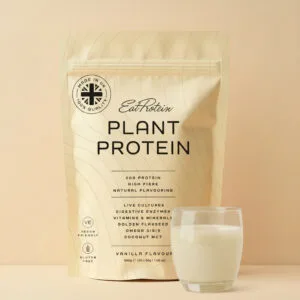
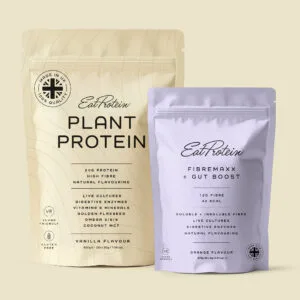
EatProtein’s Vegan Protein takes the synbiotic approach — combining prebiotic fibre from chicory root inulin with live cultures and digestive enzymes in every shake. That means you’re feeding your gut bacteria, introducing beneficial strains, and supporting digestion all at once. It’s protein with purpose.
Together, they cover the full spectrum of gut support — prebiotics, probiotics, and digestive enzymes — in a way that fits naturally into your routine.
And for those interested in supporting the structural side of gut health, our Bovine Collagen provides the amino acids — particularly glycine, proline, and hydroxyproline — that support the structural integrity of the gut lining. A healthy gut isn’t just about bacteria; the integrity of the gut barrier matters too, and collagen plays a role in maintaining it.
Building Your Gut Support Routine
Starting a new supplement doesn’t need to be complicated. Here’s a practical approach that works for most people.
Start with one thing
If you’re new to gut health supplements, begin with a prebiotic fibre. It’s the most foundational form of gut support — feeding the bacteria you already have — and it’s gentle enough to ease into. Start with half the recommended serving for the first week, then build up to the full dose as your gut adjusts. A little initial bloating is completely normal and usually settles within a week or two.
Layer in over time
Once your prebiotic is part of your daily rhythm, you can add a probiotic or switch to a synbiotic formula that combines both. If you notice discomfort after meals, digestive enzymes are worth introducing alongside your other supplements. There’s no rush — building your routine gradually gives your body time to respond and lets you notice what’s making a difference.
Be consistent
Consistency matters more than timing. Whether you take your supplements in the morning, at lunch, or in the evening, what counts is doing it daily. Your gut microbiome thrives on routine — a steady supply of prebiotic fibre gives your beneficial bacteria the reliable fuel source they need to flourish. Pick a time that works with your life and stick with it.
Keep the bigger picture in mind
Supplements work best when they’re part of a wider approach to gut health. Continue prioritising fibre-rich whole foods — fruits, vegetables, legumes, whole grains, and fermented foods like yoghurt and kimchi. Stay hydrated. Move your body regularly. Your gut supplements are the consistent daily boost that supports everything else you’re already doing.
Signs Your Gut Could Benefit from Extra Support
Everyone’s gut is different, and there’s no single checklist that applies to everyone. But there are some common signals that suggest your microbiome might appreciate a little more attention. If any of these feel familiar, a well-chosen supplement could be a meaningful addition to your routine.
- Irregular digestion — whether that’s bloating, constipation, or things generally not feeling settled
- Low energy — your gut plays a role in nutrient absorption and energy production, so persistent tiredness can sometimes trace back to digestive health
- Skin changes — breakouts, dullness, or sensitivity that doesn’t respond to topical products. The gut-skin connection is well-documented
- Diet gaps — if your fibre intake is below the recommended 30g per day (and for most people, it is), a prebiotic supplement helps close that gap
- Post-antibiotic recovery — antibiotics are sometimes necessary, but they can disrupt your microbiome. A synbiotic supplement supports your gut as it rebuilds
If you’re curious about more detailed signs your gut might need attention, our dedicated guide goes deeper into what to look for and what those signals mean.
You don’t need to be experiencing symptoms to benefit from a prebiotic either. Supporting your microbiome proactively is one of the simplest things you can do for your long-term health.
Your Gut, Your Choice
Choosing a gut health supplement is a personal decision, and the best one is the one that fits your body, your goals, and your lifestyle. Now that you understand the landscape — prebiotics, probiotics, synbiotics, enzymes, and what to look for on a label — you’re in a strong position to choose with confidence.
At EatProtein, we believe great gut support should be simple, transparent, and rooted in good science. That’s why our Prebiotic Fibre is built on one of the most researched ingredients available, and why our Vegan Protein combines prebiotics, live cultures, and enzymes in a single, thoughtful formula.
Ready to start supporting your gut? Explore EatProtein’s Prebiotic Fibre and Vegan Protein — designed to work together for complete microbiome support, made in the UK, and free from artificial sweeteners.
References
- Gibson, G.R., Hutkins, R., Sanders, M.E., et al. (2017). Expert consensus document: The International Scientific Association for Probiotics and Prebiotics (ISAPP) consensus statement on the definition and scope of prebiotics. Nature Reviews Gastroenterology & Hepatology, 14:491–502. View source
- Hill, C., Guarner, F., Reid, G., et al. (2014). Expert consensus document: The International Scientific Association for Probiotics and Prebiotics consensus statement on the scope and appropriate use of the term probiotic. Nature Reviews Gastroenterology & Hepatology, 11:506–514. View source
- Swanson, K.S., Gibson, G.R., Hutkins, R., et al. (2020). The International Scientific Association for Probiotics and Prebiotics (ISAPP) consensus statement on the definition and scope of synbiotics. Nature Reviews Gastroenterology & Hepatology, 17:687–701. View source
- Ianiro, G., Pecere, S., Giorgio, V., et al. (2016). Digestive enzyme supplementation in gastrointestinal diseases. Current Drug Metabolism, 17(2):187–193. View source
- Niness, K.R. (1999). Inulin and oligofructose: what are they? Journal of Nutrition, 129(7 Suppl):1402S–6S. View source
- NHS. (2022). How to get more fibre into your diet. NHS.uk. View source
- Markowiak, P., & Slizewska, K. (2017). Effects of probiotics, prebiotics, and synbiotics on human health. Nutrients, 9(9):1021. View source