You already know collagen is good for you. You’ve read about it, you’ve thought about adding it to your routine, and maybe you’ve even bought a tub of powder or a box of capsules that’s sitting somewhere in your kitchen right now. Unopened. Or opened once, used for a week, and then quietly forgotten about.
You’re not alone. The biggest challenge with collagen isn’t finding a good product — it’s actually taking it consistently enough for it to work. Because collagen isn’t a one-off fix. It’s a slow, steady investment in your skin, hair, nails, and joints — and it only pays off when you show up for it every day.
So what if you didn’t have to remember at all? What if your daily collagen just happened — because it was already built into something you were reaching for anyway?
That’s the idea behind collagen snacks. And it might be the simplest wellness upgrade you’ll ever make.
The Consistency Problem with Collagen
Here’s the thing about collagen that most brands don’t talk about: consistency matters more than dose. Taking 10,000mg once a week isn’t going to do as much for your skin as 6,000mg taken every single day. The benefits — firmer-feeling skin, stronger hair, healthier nails, more comfortable joints — are cumulative. They build over weeks and months of daily intake. Skip a day here and there, no problem. Skip most days, and you’re unlikely to notice much.
This is where traditional collagen formats can run into trouble. Not because the products don’t work — they do. But because they rely on you to remember, prepare, and prioritise them in a day already full of competing demands.
- Powders need mixing. That means finding a glass, measuring a scoop, stirring or blending, and cleaning up. It’s not complicated, but it’s just enough friction that it’s easy to skip when you’re rushing out the door
- Capsules need remembering. If you’re not already in the habit of taking supplements, adding another bottle to the routine means building a new habit from scratch
- Liquid collagen needs refrigeration and often doesn’t taste great. It works, but it doesn’t exactly feel like a treat
None of these formats are bad. They all deliver collagen, and they all work when you use them. The question is simply: will you use them? Consistently? For months? Because that’s what it takes for the results to show up.
Why Snacks Change the Equation
You’re already snacking. Whether it’s something mid-morning to bridge the gap to lunch, a 3pm pick-me-up when your energy dips, or a little something after dinner while you watch telly — snacking isn’t a habit you need to build. It’s one you already have.
Collagen snacks work because they borrow that existing habit. You’re not adding a step to your routine. You’re not remembering an extra supplement. You’re simply choosing a snack that happens to deliver a meaningful dose of collagen alongside the protein, flavour, and satisfaction you were looking for anyway.
That’s it. That’s the entire strategy. And it’s surprisingly effective, because the best supplement routine is always the one you don’t have to think about.
What Collagen Actually Does for Your Body
Collagen is the most abundant protein in your body — it makes up roughly a third of your total protein content. It’s the structural framework that holds your skin, hair, nails, bones, tendons, and joints together. Think of it as the scaffolding that keeps everything firm, flexible, and resilient.
Your body produces collagen naturally, but that production starts to slow from your mid-twenties onwards. It’s a gradual process, and it’s completely normal — but it does mean that over time, the collagen your body breaks down each day starts to outpace what it produces. Supplementing with collagen peptides helps to close that gap.
Skin elasticity and hydration
When you consume hydrolysed collagen, the peptides travel to your skin’s dermis layer, where they stimulate fibroblasts — the cells responsible for producing new collagen. Over time, this supports skin that feels more supple, looks more hydrated, and maintains its natural bounce. It’s not about chasing perfection — it’s about giving your skin what it needs to feel its best. Our gut-skin connection guide explores the relationship between what you eat and how your skin looks and feels.
Hair strength
Your hair follicles are surrounded by collagen-rich tissue. As collagen production slows, the support around those follicles can weaken, which may contribute to hair that feels thinner over time. Supplementing with collagen provides the amino acids — glycine, proline, and hydroxyproline — that your body uses to maintain the connective tissue around your follicles. It’s foundational support that builds steadily with consistent intake.
Nail health
If your nails have been splitting, peeling, or breaking more easily than they used to, it might not be about what you’re putting on them — it might be about what you’re giving your body to build them with. Research has shown that collagen supplementation can improve nail growth rate and reduce brittleness. It’s one of those benefits people often notice early, simply because nail growth is faster and more visible.
Joint comfort
Collagen is a major component of your cartilage — the flexible tissue that cushions your joints. Whether you’re a runner, a yoga enthusiast, or someone who’s noticed that getting up from the sofa has started to involve a sound effect, collagen supports those connective tissues from the inside. The research is encouraging, particularly for active women who put regular demands on their joints.
How Much Collagen Do You Need Per Day?
The most well-researched range for daily collagen intake is 5,000 to 15,000mg. Most clinical studies showing benefits for skin, hair, nails, and joints use doses within this range, with many showing significant results at the lower end — around 5,000 to 10,000mg daily.
Here’s what matters more than hitting a specific number: taking it every day. A consistent 6,000mg daily will do more for you than an occasional 15,000mg. Collagen isn’t a quick fix — it’s a daily practice, and showing up consistently is what delivers the results.
EatProtein’s Protein Wafers deliver 6,000mg of collagen per bar — sitting comfortably within the researched range. If you’re also getting collagen from EatProtein’s wider collagen range, a single wafer can be the consistent baseline that keeps your daily intake on track without any thought required.
Collagen Snack Formats: What’s Out There
The collagen snack space has grown significantly in recent years. Here’s a look at the main formats you’ll find:
Collagen wafer bars
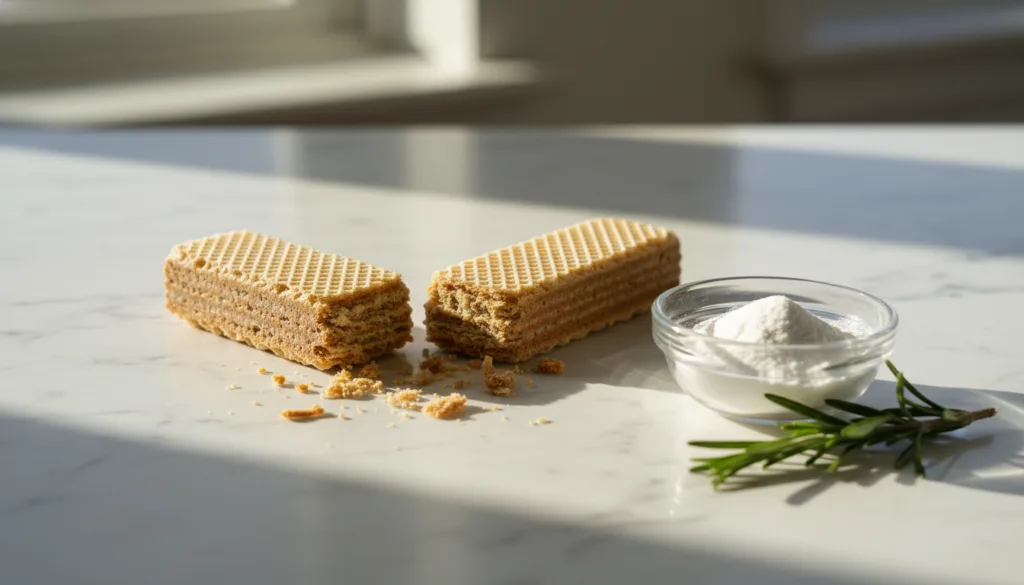
This is EatProtein’s specialty. Protein wafers with built-in collagen combine a light, crispy wafer texture with a protein cream filling and a meaningful dose of collagen. The format works beautifully because the eating experience feels like a genuine treat — think crispy layers, smooth filling, a satisfying snap — while the nutrition is doing serious work behind the scenes. EatProtein’s wafers deliver up to 15g of protein and 6,000mg of collagen from just 162 calories.
Collagen protein bars
Denser and chewier than wafers, collagen protein bars tend to be more filling and higher in calories — better suited as a meal bridge than a light afternoon snack. The collagen content varies widely between brands, so check the label: some contain a token amount, while others deliver a genuinely useful dose.
Collagen bites and balls
Smaller, pop-in-your-mouth formats that are often lower in collagen per serving but convenient for on-the-go. You may need two or three to match the collagen content of a single wafer bar.
All of these formats have a place. The best one for you is the one that fits most naturally into how you already snack. The point isn’t finding the “perfect” format — it’s finding one you’ll actually eat, every day, without thinking about it.
Bovine Collagen: Why EatProtein Chose It
You’ll notice some collagen products use bovine (cow) collagen while others use marine (fish). Both are well-researched and both have genuine merit. EatProtein chose bovine collagen for their collagen range, and the reasons are worth understanding.
Bovine collagen is rich in Type I and Type III collagen — the two types most relevant to skin elasticity, hair strength, nail health, and joint support. It contains all essential amino acids, making it a complete protein source — so the collagen in EatProtein’s products isn’t just supporting your skin and joints, it’s contributing genuine, high-quality protein to your daily intake.
The collagen is hydrolysed, meaning it’s been broken down into smaller peptides that your body can absorb efficiently — ready to use without further digestion. The amino acid profile is particularly rich in glycine, proline, and hydroxyproline, the three amino acids your body uses most actively in collagen synthesis.
Whether you prefer bovine or marine collagen is a personal choice, and both are valid. EatProtein’s decision comes down to the well-rounded amino acid profile and the strong research supporting its benefits for skin, hair, nails, and joints.
What to Look for in a Collagen Snack
Not all collagen snacks are created equal. If you’re choosing one to make part of your daily routine, here’s what’s worth checking:
- A meaningful collagen dose — at least 5,000mg per serving. Some products include collagen as a label claim at doses too low to make a real difference
- Quality protein alongside the collagen — a good collagen snack includes additional protein sources so you’re getting a complete nutritional profile, not just collagen alone
- A calorie count that makes sense — if your collagen snack is 400 calories, it’s more of a meal. A lower calorie count gives you more flexibility for daily use
- Taste you actually enjoy — if you don’t look forward to eating it, you won’t eat it consistently, and consistency is everything with collagen
EatProtein’s Protein Wafers deliver 6,000mg of bovine collagen and up to 15g of protein per bar, from just 162 calories. They’re designed to be the collagen snack you’ll actually reach for every day — because that’s the only way collagen works.
Building Collagen into Your Day (Without Building a Routine)
The beauty of collagen snacks is that they don’t require you to change anything about your day. They just make the things you’re already doing work a little harder for you.
- Mid-morning — if you had an early breakfast and lunch is still a way off, a collagen wafer bridges the gap. You get sustained energy from the protein, a satisfying crunch that feels like a proper treat, and 6,000mg of collagen before noon
- The 3pm rescue — this is prime collagen snack territory. Your energy is dipping, you want something sweet and satisfying, and you’ve got a choice: reach for a biscuit that’ll spike and crash your blood sugar, or reach for a Protein Wafer that’ll sustain your energy, satisfy the craving, and deliver your collagen for the day
- Post-workout — your body needs protein to support recovery, and your joints could use some collagen love after a good session. A wafer in your gym bag covers both — no shaker bottle required
- On the go — individually wrapped, portable, no refrigeration needed. Whether you’re commuting, travelling, or running errands, a collagen snack goes wherever you go
Notice what’s missing from that list? A new habit. A reminder on your phone. A mixing ritual. You’re just snacking — something you were going to do anyway — and the collagen is along for the ride.
Collagen Snacks and the Bigger Picture
Collagen snacks aren’t meant to replace a balanced diet — they’re meant to make one specific thing effortless: getting your daily collagen. And when that’s handled, it frees up mental energy for everything else.
If you’re already exploring high-protein snacks, collagen wafers fit right in alongside other smart options. Pair them with protein crisps when you want something savoury, or protein chocolate when the sweet tooth calls. Whatever you’re in the mood for, you’re making a choice that supports your body. EatProtein’s full snack range makes it easy to keep things interesting.
And if collagen is something you want to explore more deeply, EatProtein’s wider collagen range gives you options beyond snacks — so you can build the daily intake that feels right for you.
The Simplest Collagen Routine You’ll Ever Have
Most wellness routines start with good intentions and end with a cupboard full of half-used products. Collagen snacks are the antidote to that cycle. They work because they don’t feel like a routine at all. There’s no preparation, no timing, no steps to remember. Just a snack in your bag or your desk drawer — and a body that’s quietly receiving the collagen it needs, day after day.
That’s the real power of collagen snacks. They simply remove every barrier between you and the consistency that collagen requires to work. And consistency, as it turns out, is the whole game.
Ready to make your daily collagen effortless? Explore EatProtein’s Protein Wafers — 6,000mg of collagen, up to 15g of protein, from just 162 calories. Your new favourite snack, with built-in benefits for your skin, hair, nails, and joints.
References
- de Miranda, R. B., Weimer, P., & Rossi, R. C. (2021). Effects of hydrolyzed collagen supplementation on skin aging: a systematic review and meta-analysis. International Journal of Dermatology, 60(12), 1449–1461. View source
- Proksch, E., Segger, D., Degwert, J., Schunck, M., Zague, V., & Oesser, S. (2014). Oral supplementation of specific collagen peptides has beneficial effects on human skin physiology: a double-blind, placebo-controlled study. Skin Pharmacology and Physiology, 27(1), 47–55. View source
- Hexsel, D., Zague, V., Schunck, M., Siega, C., Camozzato, F. O., & Oesser, S. (2017). Oral supplementation with specific bioactive collagen peptides improves nail growth and reduces symptoms of brittle nails. Journal of Cosmetic Dermatology, 16(4), 520–526. View source
- Clark, K. L., Sebastianelli, W., Flechsenhar, K. R., Aukermann, D. F., Meza, F., Millard, R. L., Deitch, J. R., Sherbondy, P. S., & Albert, A. (2008). 24-Week study on the use of collagen hydrolysate as a dietary supplement in athletes with activity-related joint pain. Current Medical Research and Opinion, 24(5), 1485–1496. View source
- Shoulders, M. D., & Raines, R. T. (2009). Collagen structure and stability. Annual Review of Biochemistry, 78, 929–958. View source
- Gkogkolou, P., & Böhm, M. (2012). Advanced glycation end products: key players in skin ageing? Dermato-endocrinology, 4(3), 259–270. View source