You probably don’t spend much time thinking about what your shaker bottle is made from. It holds your shake, you drink it, job done. But the material between your hand and your drink is doing more than you realise — affecting how your shake tastes, how long it stays fresh, what’s leaching into it, and how long the bottle actually lasts.
Stainless steel isn’t just a premium-looking upgrade from plastic. There’s genuine science behind why it’s the smarter choice — from the molecular structure of the steel itself to the physics of vacuum insulation. Here’s the deeper look that most shaker reviews skip entirely.
The Science of Food-Grade Stainless Steel
Not all stainless steel is the same. The grade that matters for anything touching your food or drink is 304 stainless steel, also known as 18-8. Those numbers refer to its composition — 18% chromium and 8% nickel. It’s the same grade used in professional kitchens, surgical instruments, brewery tanks, and food processing equipment worldwide.
What makes 304 stainless steel special is its chromium content. When exposed to oxygen, chromium forms a thin, invisible layer of chromium oxide on the surface of the steel. This passive layer is what makes stainless steel “stainless” — it’s self-healing (if scratched, it reforms), corrosion-resistant, and completely non-reactive with food and drink.
In practical terms, this means:
- Non-porous — the surface has no microscopic holes or texture for bacteria, mould, or residue to hide in
- Non-reactive — acids (like citrus in your smoothie), proteins, and flavourings don’t interact with the metal. Nothing transfers in either direction
- Corrosion-resistant — it won’t rust, pit, or degrade with daily use and washing
- Taste-neutral — your drink tastes like your drink, not like the container it’s in
This is why food-grade stainless steel is the default material in any industry where hygiene and chemical neutrality are non-negotiable. It’s not a marketing choice — it’s an engineering one.
Health Benefits: What’s Not in Your Drink
When it comes to what touches your food and drink, sometimes the most important thing is what isn’t there. Stainless steel’s health advantage comes down to one simple fact: it doesn’t leach.
No BPA. Bisphenol A is linked to hormonal disruption, particularly oestrogen mimicry — which is why most plastic products now carry “BPA-free” labels. But BPA is just one chemical in a larger family. BPS, BPF, and other replacements are increasingly found in BPA-free plastics, and the conversation about their safety is still evolving.
No phthalates. These plasticisers are added to make plastics flexible — common in soft-touch coatings, seals, and flexible lids. Like BPA, they’re endocrine disruptors that can leach into liquids, particularly warm ones.
No microplastics. Every time plastic is used, washed, or exposed to temperature changes, it sheds tiny particles. Research into the health effects of ingesting microplastics is still developing, but the direction of findings is giving scientists pause.
Stainless steel sidesteps all of this. It’s inherently free from BPA, phthalates, and plastic-derived chemicals — not because of special labelling, but because it’s an inert alloy. Nothing to leach, nothing to shed, nothing to worry about. For something you drink from every day, that quiet reassurance matters.
How Double-Walled Vacuum Insulation Actually Works
You’ve probably heard that double-walled bottles keep drinks cold. But how? The answer is satisfyingly simple physics.
A double-walled vacuum-insulated bottle has two walls of stainless steel with a vacuum — a near-complete absence of air — sealed between them. Heat moves in three ways: conduction (through direct contact), convection (through moving air), and radiation (through electromagnetic waves). A vacuum eliminates two of these entirely.
- Conduction — with no air molecules between the walls, heat can’t travel from the outer wall to the inner wall. The only path is through the narrow rim where the walls meet
- Convection — no air means no air currents. Without gas molecules to carry heat, convection can’t happen in the gap
- Radiation — a vacuum can’t block this entirely, but quality bottles use reflective inner coatings that bounce radiant heat back, minimising the effect
The result? Your cold shake stays cold for hours. The outside stays dry — no condensation dripping into your bag. Compare this to plastic, which offers zero insulation. If there’s any gap between making your shake and drinking it — a commute, a gym session, a busy morning — the difference is significant.
The Taste Test: Why Quality Steel Tastes Like Nothing
Doesn’t stainless steel make drinks taste metallic? Not when it’s quality steel — and the science explains why.
Food-grade 304 stainless steel is non-reactive. The chromium oxide layer acts as a barrier between the steel and whatever it’s holding. Acids, proteins, flavourings — none of them interact with the metal. Your shake tastes exactly the way it should.
If you’ve ever experienced a metallic taste from a metal bottle, it was likely a lower grade of steel (some budget bottles use 201, which contains more manganese and less nickel) or aluminium, which is reactive and requires a plastic lining to be food-safe. Quality 304 stainless steel is invisible to your taste buds — which is why it’s the material of choice in wine tanks, coffee equipment, and craft brewing.
And because stainless steel is non-porous, it doesn’t absorb flavours either. Your morning protein shake won’t carry a ghost of yesterday’s berry smoothie. Every drink starts completely fresh — something that becomes quietly impossible with plastic over time.
Durability: Dent vs Crack
Drop a plastic shaker enough times and you’ll eventually see hairline cracks, stress marks around the lid threads, or chips along the rim. One of those drops will produce a crack that leaks. Most plastic shakers last six to eighteen months of daily use before they need replacing.
Drop a stainless steel shaker, and the worst that happens is a dent. Cosmetically annoying, perhaps — but functionally irrelevant. It still seals, still insulates, still holds your shake exactly as it did before. Stainless steel doesn’t crack, shatter, warp in a hot car, or lose structural integrity over time.
A well-made stainless steel shaker is a multi-year product — not because of careful handling, but because the material simply lasts. After two years of daily use, it looks and functions almost identically to the day you bought it. That durability changes the economics entirely. Divide the price by the years you’ll use it, subtract the plastic shakers you won’t be replacing, and stainless steel is comfortably the better value.
Hygiene: The Non-Porous Advantage
Hygiene in a shaker isn’t just about washing it — it’s about what happens at the surface level.
Plastic, even when new, has a microscopically textured surface. Over time, scratches from mixing mechanisms and daily use multiply those imperfections. Bacteria, mould spores, and protein residue find their way into tiny crevices that washing can’t always reach. That’s why a well-used plastic shaker develops a persistent smell that no amount of scrubbing fully removes — the odour isn’t on the surface, it’s embedded in it.
Stainless steel is smooth and non-porous at a microscopic level. No crevices for bacteria, no texture for residue, no absorption beneath the surface. When you wash a stainless steel shaker, it gets actually clean — not just visually clean. This is why stainless steel is the mandated material in hospitals, commercial kitchens, and pharmaceutical manufacturing. For a protein shaker used daily with protein residue — an excellent food source for bacteria — that difference in surface hygiene is genuinely meaningful.
The Environmental Story
The sustainability case for stainless steel doesn’t require any guilt — it’s just straightforward maths.
A plastic shaker replaced every year means five bottles in five years — each manufactured, shipped, used, and discarded. Most mixed-material plastic bottles aren’t easily recyclable in practice, regardless of the recycling symbol. They end up in landfill, where plastic doesn’t biodegrade — it fragments into microplastics over centuries.
A stainless steel shaker used for five years is one product. One manufacturing cycle. One shipping journey. And when it eventually reaches the end of its very long life, stainless steel is 100% recyclable — infinitely, without any loss of quality. Steel is already one of the most recycled materials on the planet.
Choosing stainless steel isn’t about making a statement. It’s about making a sensible decision — one product that lasts, instead of many that don’t.
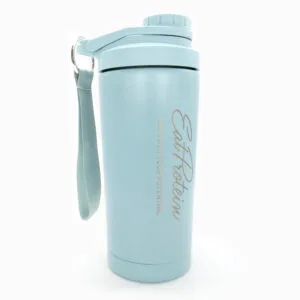
EatProtein’s double-walled stainless steel shaker is built from premium food-grade steel, vacuum-insulated to keep your shakes cold for hours, 100% leak-proof, and fitted with a silent mixer — no rattling wire ball. It’s designed to be the last shaker you buy. Thoughtful details, premium materials, and a design made for women who take their wellness seriously.
What to Look for When Choosing a Stainless Steel Shaker
Not all stainless steel bottles are equal. Here’s what separates a good shaker from a great one.
- Food-grade 304 (18-8) steel — anything less compromises corrosion resistance and can introduce the metallic taste people worry about. If a brand doesn’t specify the grade, that’s worth questioning
- Double-walled vacuum insulation — single-walled steel won’t keep drinks cold. Insulation is what transforms the experience
- Leak-proof engineering — a shaker lives in bags, in cars, on gym floors. Look for precision-engineered lids, not just screw-tops with rubber gaskets
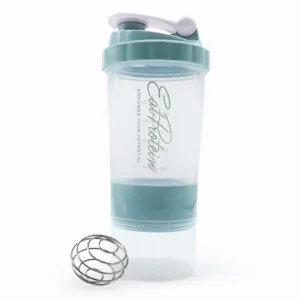
- Silent mixing mechanism — wire whisk balls rattle loudly in steel. The best shakers use alternative systems that blend effectively without the noise
- Wide mouth — for easy filling, easy cleaning, and adding ice. A narrow opening is a daily frustration
- Considered capacity — 500ml to 700ml suits most people. Enough room for your shake, space for the mixer to work, and not so large it’s cumbersome
The Smarter Choice
Stainless steel isn’t just a material upgrade — it’s a daily experience upgrade. Better taste. Better temperature. Better hygiene. Better durability. Better for the planet. Every advantage compounds over time, turning a slightly higher upfront cost into genuinely better value.
The science backs it up. Food-grade 304 stainless steel is non-reactive, non-porous, and naturally free from every chemical that makes plastic controversial. Double-walled vacuum insulation keeps your shakes cold using simple, reliable physics. And the material’s inherent durability means your shaker keeps performing for years, not months.
It’s about choosing the material that works best for something you use every single day — and enjoying the quiet confidence that comes with knowing your shaker is as considered as everything you put inside it.
For the full comparison between materials, our stainless steel vs plastic guide breaks down every difference. And if you’re exploring shakers more broadly, our guide to the best protein shakers covers what to look for across every material and budget.
Ready to make the switch? Explore EatProtein’s stainless steel shaker — double-walled, leak-proof, silent mixer, and designed for women who expect more from their kit.
References
- Food Standards Agency. (2024). BPA in plastic. Food Standards Agency. View source
- Darbre, P. D. (2022). An insight into bisphenol A, food exposure and its adverse effects on health: A review. PMC / Environmental Research. View source
- KitchenSanity. (2024). What is food-grade stainless steel? Is it safe?. KitchenSanity. View source
- Ecowayhouse. (2023). What is a thermos? The science and factory guide to vacuum flasks. Ecowayhouseware. View source
- BioCote. (2023). Hygienic protein shaker bottles: contamination and microbial risk in drinking vessels. BioCote. View source
- Unified Alloys. (2023). Sustainability meets durability: the environmental benefits of stainless steel. Unified Alloys. View source