At EatProtein, every ingredient earns its place. When we developed our Prebiotic Fibre, we chose chicory root inulin as the foundation — and we think you deserve to know exactly why. Here’s everything you need to know about chicory root fibre: what it is, what the research actually says, and what to expect when you start taking it.
What Is Chicory Root Fibre?
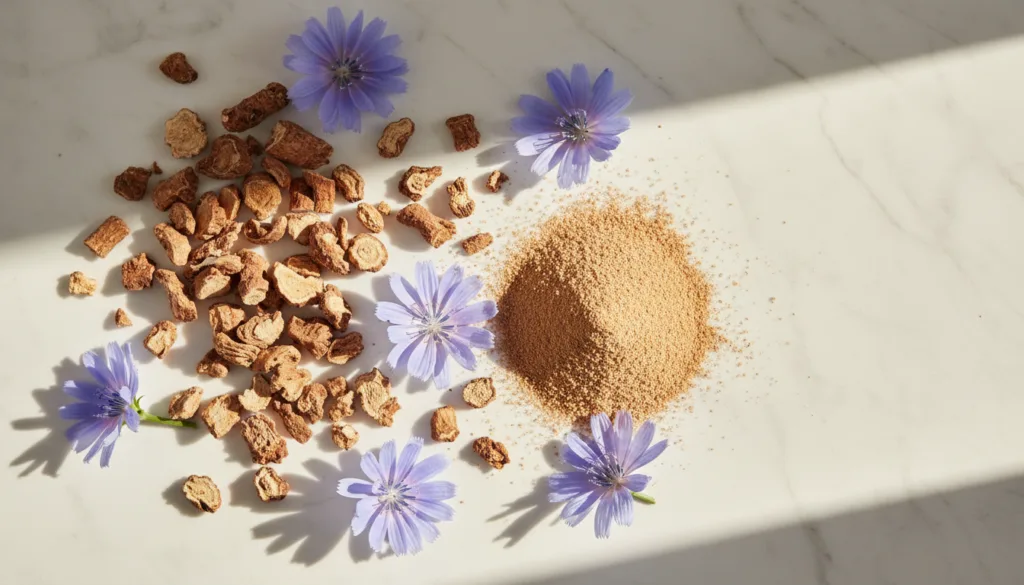
Chicory root fibre comes from the root of the chicory plant (Cichorium intybus) — a blue-flowered perennial that’s been used for centuries in food and herbal medicine. The root is naturally rich in inulin, a type of soluble prebiotic fibre that your body doesn’t digest in the usual way. Instead, it travels intact to your large intestine, where it does something rather clever.
To extract the inulin, chicory roots are harvested, sliced, and soaked in hot water — a process similar to brewing tea. The resulting extract is filtered and dried into a fine, neutral-tasting powder. No harsh chemicals, no complicated processing. Just a naturally concentrated source of prebiotic fibre from a single plant.
Inulin belongs to a group of carbohydrates called fructans — chains of fructose molecules linked together in a way that our digestive enzymes can’t break down. That’s actually the point. Because your stomach and small intestine can’t digest inulin, it arrives in your colon intact — ready to feed the bacteria that live there.
How Chicory Root Inulin Works as a Prebiotic
You’ve probably heard the word “prebiotic” used alongside “probiotic,” but they do very different things. Probiotics are the live bacteria themselves. Prebiotics are what those bacteria eat. Chicory root inulin is one of the most well-studied prebiotics available — and here’s how it works once it reaches your gut.
When inulin arrives in your large intestine, the beneficial bacteria already living there — particularly Bifidobacteria and Lactobacilli — ferment it as a food source. This fermentation process does two important things:
- It helps those beneficial bacteria grow and multiply — increasing their numbers relative to less helpful microbes. Over time, this shifts the balance of your gut microbiome in a positive direction.
- It produces short-chain fatty acids (SCFAs) — particularly butyrate, propionate, and acetate. These fatty acids nourish the cells lining your colon, help maintain the integrity of your gut barrier, and have anti-inflammatory effects throughout your body.
Think of it as tending a garden. You’re not planting new seeds — you’re feeding the good plants that are already there, helping them thrive so they crowd out the weeds. That’s the prebiotic approach, and chicory root inulin is one of the most effective and well-researched ways to do it.
This is also why our gut-skin connection guide explores how what’s happening inside your digestive system shows up on the outside. A well-supported microbiome doesn’t just improve digestion — it can influence your skin, your energy, and how you feel day to day.
5 Evidence-Backed Benefits of Chicory Root Fibre
Chicory root inulin is one of the most studied prebiotic fibres in nutrition research. Here’s what the evidence consistently supports.
1. Digestive health and regularity
Inulin increases stool frequency and improves consistency — gently and naturally. A 2017 randomised controlled trial published in the International Journal of Food Sciences and Nutrition found that chicory inulin supplementation significantly improved bowel habits. It works by drawing water into the intestine and increasing the bulk produced by bacterial fermentation, which keeps things moving comfortably.
2. Calcium and mineral absorption
This is one of the more surprising benefits. The short-chain fatty acids produced when your gut bacteria ferment inulin lower the pH in your colon, which makes minerals — particularly calcium and magnesium — more soluble and easier for your body to absorb. Research published in the Journal of Nutrition has shown that inulin-type fructans can increase calcium absorption by up to 20% in adolescents and postmenopausal women. For anyone thinking about long-term bone health, that’s a meaningful difference.
3. Blood sugar management
Soluble fibre slows the rate at which food moves through your digestive system, which helps prevent the sharp spikes and crashes in blood sugar that leave you reaching for another snack an hour after eating. Studies on inulin supplementation have shown modest but consistent improvements in fasting blood sugar and insulin sensitivity, particularly in people with pre-diabetes. It’s not a replacement for medical advice — but as part of a balanced diet, it’s a quiet, steady support.
4. Satiety and appetite
Inulin affects the production of appetite-regulating hormones — specifically GLP-1 and peptide YY — which signal to your brain that you’re satisfied. A study in the European Journal of Clinical Nutrition found that participants consuming inulin-type fructans reported feeling fuller and consumed fewer calories at subsequent meals. It’s not dramatic — it’s a gentle, natural shift in how hungry you feel between meals.
5. Cholesterol support
The short-chain fatty acids produced during inulin fermentation — propionate in particular — influence cholesterol metabolism in the liver. Meta-analyses have found that inulin supplementation can modestly reduce total cholesterol and LDL cholesterol levels over time. The effect is subtle rather than transformative, but combined with good nutrition and an active lifestyle, it’s another way your gut health supports your whole body.
Side Effects: What to Expect (Honestly)
Here’s where we want to be completely transparent, because this is the part that puts some people off — and it really shouldn’t.
When you first start taking chicory root fibre, you may experience some bloating and gas. This is common. It’s also temporary. And it’s actually a sign that the prebiotic is doing exactly what it’s supposed to do.
Here’s why it happens: when those beneficial bacteria in your gut start fermenting the inulin, they produce gas as a byproduct. If your gut microbiome isn’t used to this kind of fibre, the initial adjustment period can feel a bit uncomfortable. Most people find it settles within one to two weeks as their gut bacteria adapt.
How to minimise the adjustment
- Start with a smaller serving — half the recommended dose is a sensible starting point. Give your gut a week to adjust before building up.
- Stay hydrated — soluble fibre works best when there’s plenty of water to work with. Drink a full glass with your serving.
- Be consistent — daily use helps your microbiome adapt. Sporadic use can keep restarting the adjustment period.
- Give it time — most initial discomfort resolves within 7–14 days. If you’re still struggling after three weeks, reduce the dose and build up more slowly.
Who should be cautious
If you’re managing IBS or have a known sensitivity to FODMAPs (fermentable carbohydrates), chicory root inulin may trigger symptoms more easily. That doesn’t necessarily mean you need to avoid it entirely — but it’s worth starting at a very low dose and monitoring how your body responds. If you have a diagnosed digestive condition or you’re on medication, check with your GP before adding any new supplement.
We’d rather tell you this upfront than have you surprised. Honesty about what to expect is part of how we do things.
Why We Chose Chicory Root Inulin
When we were developing EatProtein’s Prebiotic Fibre, we looked at every major fibre source on the market. Psyllium husk. Methylcellulose. Wheat dextrin. Acacia fibre. Each has its place — but chicory root inulin stood out for several reasons.
- It’s one of the most researched prebiotic fibres available — decades of clinical studies, not just early-stage research. We know what it does and how it works.
- It’s naturally plant-based — extracted from chicory root using a simple hot-water process. No synthetic manufacturing, no artificial modification.
- It has genuine prebiotic action — not all fibres feed your gut bacteria. Chicory root inulin specifically and selectively nourishes beneficial strains, which is why it’s classified as a true prebiotic.
- It’s clean and neutral-tasting — mixes easily into drinks, smoothies, or food without changing the flavour or texture.
- It aligns with our no-nasties philosophy — our Prebiotic Fibre contains no artificial sweeteners, no fillers, and is made right here in the UK.
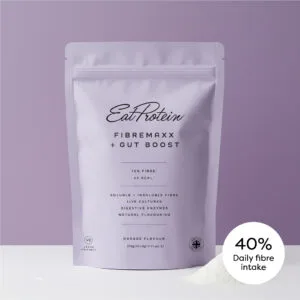
Our Prebiotic Fibre is built on chicory root inulin — clean, plant-based, and designed to support your microbiome from the inside out. No artificial sweeteners, no unnecessary extras. Just thoughtful nutrition your gut will thank you for.
It’s also worth knowing that chicory root inulin isn’t just in our standalone fibre. Our vegan protein is formulated with prebiotic fibre from chicory root inulin alongside live cultures and digestive enzymes — because we believe great nutrition should support your digestion, not work against it.
How to Take Chicory Root Fibre
One of the best things about chicory root inulin is how easy it is to work into your day. It’s a fine, neutral powder that dissolves quickly and doesn’t change the taste or texture of whatever you add it to.
Practical ways to use it
- Stir it into water or juice — the simplest option. Mix, drink, done.
- Blend it into a smoothie — add it alongside your favourite fruits, greens, or protein powder. You won’t taste it.
- Mix it into porridge or overnight oats — stir it in while cooking or fold it into the mixture before refrigerating.
- Add it to coffee or tea — it dissolves in hot or cold liquids without affecting the flavour.
Building up your dose
If you’re new to prebiotic fibre, start with around half the recommended serving for the first week. This gives your gut bacteria time to adjust without overwhelming them. After a week, move up to the full serving. If you’re particularly sensitive, take two weeks at the lower dose before increasing. There’s no rush — consistency matters more than speed.
Take it at whatever time works for you. Morning, afternoon, evening — the prebiotic effect isn’t time-dependent. What matters is that you take it regularly so your microbiome has a steady supply of the fibre it thrives on.
Support Your Gut, Simply
Chicory root fibre isn’t complicated, and it doesn’t need to be. It’s a natural, well-researched prebiotic that feeds the good bacteria in your gut, supports your digestion, and contributes to your overall wellbeing — from mineral absorption to blood sugar balance to how satisfied you feel after a meal.
The initial adjustment is real, and we respect you enough to say so. But it passes. And what you’re left with is a simple, clean addition to your daily routine that genuinely works with your body.
EatProtein’s Prebiotic Fibre is built on chicory root inulin — no artificial sweeteners, no unnecessary ingredients, made in the UK. Just clean prebiotic support designed to help your microbiome thrive.
Ready to give your gut what it needs? Explore our Prebiotic Fibre range and start supporting your microbiome from the inside out.
References
- Niness, K.R. (1999). Inulin and oligofructose: what are they? Journal of Nutrition, 129(7 Suppl):1402S–6S. View source
- Dahl, W.J., Zank, L., & Auger, J. (2017). Effect of consumption of chicory inulin on bowel function in healthy subjects with constipation: a randomized, double-blind, placebo-controlled trial. International Journal of Food Sciences and Nutrition. View source
- Holloway, L., Moynihan, S., Abrams, S.A., et al. (2007). Effects of oligofructose-enriched inulin on intestinal absorption of calcium and magnesium and bone turnover markers in postmenopausal women. British Journal of Nutrition, 97(2):365–372. View source
- Hsu, Y.J., Chen, Y.L., Ho, S.T., et al. (2019). Inulin-type fructans supplementation improves glycemic control for the prediabetes and type 2 diabetes populations: results from a GRADE-assessed systematic review and dose–response meta-analysis of 33 randomised controlled trials. Journal of Translational Medicine. View source
- Kovatcheva-Datchary, P., & Arora, T. (2013). Nutrition, the gut microbiome and the metabolic syndrome. Best Practice & Research: Clinical Gastroenterology. View source
- Caudet, J., Navarro, J., Trujillo, M., & Vilanova, O. (2021). Assessing the effects of inulin-type fructan intake on body weight, blood glucose, and lipid profile: a systematic review and meta-analysis of randomised controlled trials. Food Science & Nutrition. View source
- NHS. (2022). How to get more fibre into your diet. NHS.uk. View source