Most of us have heard of probiotics. They’re the “good bacteria” in yoghurt, the reason everyone’s talking about kombucha, the reason fermented foods have become a wellness staple. But there’s a second half to the gut health story that most people skip entirely — and it might be the more important one.
Prebiotics. They don’t get the same attention, but without them, even the best probiotics can’t do their job properly. Think of it this way: probiotics are the seeds, and prebiotics are the fertiliser. Plant all the seeds you like — without the right soil conditions, they won’t thrive.
Here’s everything you need to know about prebiotics vs probiotics — what they are, why both matter, and how to get enough of each.
What Are Probiotics?
Probiotics are live microorganisms — beneficial bacteria and yeasts — that support your digestive system when consumed in adequate amounts. Your gut is home to trillions of bacteria, and maintaining a healthy balance between the “good” and “not-so-good” varieties is one of the most important things you can do for your overall wellbeing.
Probiotic bacteria help with:
- Digestion and nutrient absorption — they help break down food and support the uptake of vitamins and minerals
- Immune function — a significant proportion of your immune cells (estimated at around 70% in some research, though the precise figure varies) are associated with gut tissue, and a diverse microbiome helps keep your defences strong
- Mood and mental clarity — your gut produces the majority of your body’s serotonin, which is why researchers call it the “second brain”
- Skin health — a balanced gut microbiome is linked to clearer, calmer skin (there’s a reason the gut-skin connection is one of the most talked-about topics in wellness right now)
You’ll find probiotics naturally in fermented foods — live yoghurt, kefir, kimchi, sauerkraut, miso, and kombucha all contain beneficial bacterial strains. They’re also available as supplements and, increasingly, as added ingredients in functional food and drink products.
The key word is live. Probiotics need to arrive in your gut alive to have any effect. That’s why the way they’re stored, formulated, and combined with other ingredients matters more than most people realise.
What Are Prebiotics?
If probiotics are the good bacteria themselves, prebiotics are what keeps them alive and thriving. Prebiotics are a type of dietary fibre that your body can’t digest — but your gut bacteria can. They pass through your upper digestive system intact and arrive in your large intestine, where they become fuel for the beneficial bacteria already living there.
In simple terms, prebiotics feed your microbiome.
The most well-researched types of prebiotic fibre include:
- Inulin — a soluble fibre found naturally in chicory root, garlic, onions, and leeks. It’s one of the most studied prebiotics and is particularly effective at stimulating the growth of Bifidobacteria, a key group of beneficial gut bacteria
- Fructo-oligosaccharides (FOS) — closely related to inulin, found in many of the same foods. FOS has a slightly shorter chain length, which means it ferments faster in the gut
- Galacto-oligosaccharides (GOS) — found naturally in human breast milk and legumes. Particularly effective at supporting gut health and immune function
When prebiotic fibre reaches your gut bacteria, they ferment it and produce short-chain fatty acids (SCFAs) like butyrate. These SCFAs nourish the cells lining your gut, reduce inflammation, and support a healthy intestinal barrier — which has knock-on benefits for everything from your immune system to your skin.
Inulin is one of the most researched prebiotic fibres in the world — and chicory root is its richest natural source. That’s exactly why it’s the foundation of EatProtein’s Prebiotic Fibre.
The Key Difference Between Prebiotics and Probiotics
Here’s the simplest way to remember it:
- Probiotics add beneficial bacteria to your gut
- Prebiotics feed the beneficial bacteria you already have
Probiotics introduce new residents to your gut microbiome. Prebiotics make sure the neighbourhood is welcoming enough for those residents — and the ones already there — to flourish.
Both are types of gut support, but they work through completely different mechanisms. Probiotics are living organisms that need to survive the journey to your gut. Prebiotics are non-living fibre — they’re stable, they don’t need refrigeration, and they aren’t affected by heat or stomach acid.
The important thing to understand is that they aren’t interchangeable — they’re complementary. You wouldn’t plant a garden and never water it. And you wouldn’t water bare soil and expect flowers. Your gut works the same way.
Why You Need Both: The Synbiotic Effect
When you combine prebiotics and probiotics together, the effect is greater than either one alone. Researchers call this a synbiotic approach — the prebiotic fibre actively supports the survival and growth of the probiotic bacteria, making both work harder.
Here’s why this matters in practice:
- Probiotics arrive vulnerable. Live bacteria face stomach acid, bile, and competition from existing gut microbes. Many probiotic supplements lose a significant portion of their bacteria before they reach the large intestine.
- Prebiotics improve probiotic survival. When prebiotic fibre is present in the gut, it gives incoming probiotic bacteria an immediate food source — helping them colonise, multiply, and establish themselves.
- Together, they support microbiome diversity. A diverse microbiome is a resilient one. Prebiotic fibre doesn’t just feed one strain — it supports the growth of many beneficial species, creating a richer, more balanced ecosystem.
Taking a probiotic without prebiotic support is like planting seeds in poor soil. The bacteria arrive, but without fuel, they struggle to compete and may not survive long enough to make a difference. Adding prebiotic fibre changes the equation entirely.
This is why the most effective approach to gut health isn’t choosing between prebiotics and probiotics — it’s using both, consistently.
Best Prebiotic Foods to Include in Your Diet
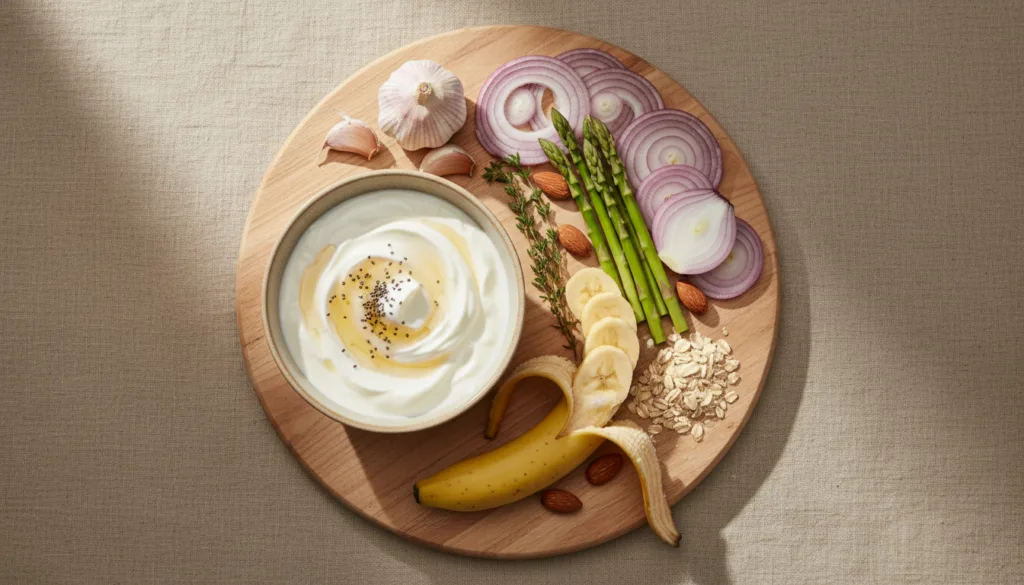
The good news is that prebiotic fibre occurs naturally in many everyday foods. The not-so-good news is that most of us aren’t eating nearly enough of them. Here are the best natural sources:
- Chicory root — the richest natural source of inulin, containing up to 65% prebiotic fibre by weight. It’s rarely eaten whole but is widely used as an extract in supplements and functional foods
- Garlic — around 11% of its fibre content is inulin and 6% is FOS. A staple in most kitchens and one of the easiest prebiotics to eat regularly
- Onions — contain inulin and FOS. Whether raw in salads or cooked in sauces, they contribute meaningful prebiotic fibre
- Leeks — closely related to onions and garlic, with a similar prebiotic profile. Lovely in soups and stews
- Asparagus — a good source of inulin. Around 2–3g of prebiotic fibre per 100g serving
- Bananas — especially slightly under-ripe ones, which contain resistant starch that acts as a prebiotic. A convenient, portable option
- Oats — contain beta-glucan, a type of soluble fibre with prebiotic properties. A morning bowl of porridge is doing more for your gut than you might think
- Jerusalem artichokes — one of the highest food sources of inulin (up to 19g per 100g). They’re seasonal and not always easy to find, but worth adding when you spot them
Eating a variety of these foods regularly is the best starting point for prebiotic support. But as with many nutrients, there’s a gap between what we should be eating and what we actually eat.
When Food Isn’t Enough: Prebiotic Supplements
The NHS recommends adults consume 30g of fibre per day. The reality? Most UK adults manage around 18g — barely more than half the target. That gap matters, because fibre isn’t just about digestion. It’s fuel for your entire gut microbiome.
There are a few reasons the fibre gap is so persistent:
- Busy schedules — convenience foods tend to be heavily processed and low in fibre
- Limited variety — eating the same meals on rotation means you’re getting the same fibres (or lack of them) repeatedly
- Portion sizes — you’d need to eat a lot of garlic or onions to get a meaningful dose of inulin from food alone
This is where a prebiotic supplement can genuinely help. It’s not about replacing whole foods — it’s about ensuring your gut bacteria have a consistent, reliable source of fuel even on days when your diet isn’t perfect.
When choosing a prebiotic supplement, look for:
- A well-researched prebiotic fibre — inulin from chicory root is the gold standard, backed by decades of clinical research
- No artificial sweeteners — many fibre supplements mask the taste with sweeteners that can actually disrupt the gut bacteria you’re trying to support
- Clean, simple ingredients — fewer ingredients usually means fewer compromises. A transparent label is a good sign
- Enough to make a difference — check the dose. A supplement that delivers just 1–2g of fibre per serving won’t close the gap meaningfully
A good prebiotic supplement is one of the simplest additions you can make to your daily routine — and one that your gut will genuinely notice.
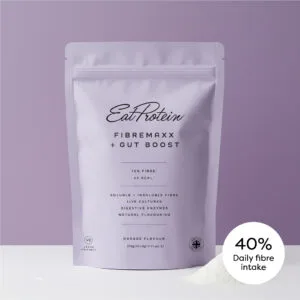
EatProtein’s Prebiotic Fibre is made from chicory root inulin — the richest natural source of prebiotic fibre. No artificial sweeteners, no unnecessary additives, UK-made. Just clean, effective fuel for your gut bacteria. For more on what makes chicory root special, our chicory root fibre guide has the full story.
The Power Pairing: Prebiotic Fibre + Live Cultures
If prebiotics and probiotics work best together, the obvious question is: how do you get both without juggling multiple supplements?
This is something we thought about carefully when developing the EatProtein range. Most brands offer one or the other — a fibre supplement here, a probiotic capsule there. We wanted to take a different approach.
EatProtein’s Prebiotic Fibre delivers the prebiotic side — chicory root inulin that feeds and fuels your existing gut bacteria. It’s the foundation.
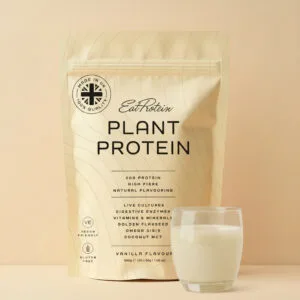
EatProtein’s Vegan Protein goes further. It’s not just protein — it contains prebiotic fibre (chicory root inulin), plus live cultures and digestive enzymes. That means in a single shake, you’re getting:
- Prebiotic fibre to feed your gut bacteria
- Live cultures to add beneficial bacteria
- Digestive enzymes to support comfortable, efficient digestion
- High-quality plant protein for energy and muscle support
It’s a synbiotic approach built into a product you’re already using — no extra capsules, no complicated routine. Just your daily shake, doing more than you’d expect.
No other UK protein brand pairs prebiotic fibre with live cultures and digestive enzymes in a single formula. EatProtein’s Vegan Protein is a complete gut health routine in one delicious shake.
A Simple Daily Gut Health Routine
Supporting your gut doesn’t need to be complicated. Here’s what a practical daily routine looks like:
- Morning — start with a serving of EatProtein’s Vegan Protein in your smoothie or with water. You’re getting protein, prebiotic fibre, live cultures, and digestive enzymes in one go.
- Throughout the day — include prebiotic-rich whole foods where you can. Oats at breakfast, garlic and onions in your cooking, a banana as a snack. Every little bit counts.
- Any time — add a serving of EatProtein’s Prebiotic Fibre to a drink, a smoothie, or stirred into yoghurt. It’s virtually tasteless and mixes easily.
That’s it. No complicated supplement stacks, no expensive protocols. Just consistent, daily support for the bacteria that do so much for how you feel, how you look, and how your body functions from the inside out.
Your gut health isn’t built in a day — it’s built in the small, consistent choices you make every day. And when those choices include both prebiotics and probiotics, you’re giving your microbiome everything it needs to thrive.
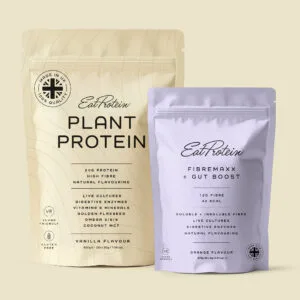
Ready to support your gut from both sides? Explore EatProtein’s Prebiotic Fibre and Vegan Protein with live cultures — your complete gut health pairing.
References
- Gibson, G.R., Hutkins, R., Sanders, M.E., et al. (2017). Expert consensus document: The International Scientific Association for Probiotics and Prebiotics (ISAPP) consensus statement on the definition and scope of prebiotics. Nature Reviews Gastroenterology & Hepatology, 14:491–502. View source
- Roberfroid, M., Gibson, G.R., Hoyles, L., et al. (2010). Prebiotic effects: metabolic and health benefits. British Journal of Nutrition, 104(Suppl 2):S1–63. View source
- Markowiak, P., & Slizewska, K. (2017). Effects of probiotics, prebiotics, and synbiotics on human health. Nutrients, 9(9):1021. View source
- Niness, K.R. (1999). Inulin and oligofructose: what are they? Journal of Nutrition, 129(7 Suppl):1402S–6S. View source
- NHS. (2022). How to get more fibre into your diet. NHS.uk. View source
- Davani-Davari, D., Negahdaripour, M., Karimzadeh, I., et al. (2019). Prebiotics: Definition, Types, Sources, Mechanisms, and Clinical Applications. Foods, 8(3):92. View source
- Pandey, K.R., Naik, S.R., & Vakil, B.V. (2015). Probiotics, prebiotics and synbiotics — a review. Journal of Food Science and Technology, 52(12):7577–7587. View source