When you learn how important collagen is for your skin, joints, hair, and gut, one of the first questions is usually: “Can I just eat more of it?”
It’s a fair question. Collagen is a protein, and protein comes from food. So in theory, eating collagen-rich foods should give your body what it needs. But in practice, it’s a bit more complicated than that.
Here’s what you need to know about collagen in food — which foods contain it, which foods help your body make more of it, and why most women find that food alone doesn’t quite get them where they want to be.
Foods That Contain Collagen
Collagen is found in the connective tissue, skin, and bones of animals. If it sounds like it’s not the most glamorous list of ingredients, you’re right — but these are the richest dietary sources:
Bone broth
The most talked-about collagen food by far. Bone broth is made by simmering animal bones and connective tissue for hours, which draws collagen out into the liquid. A good homemade bone broth can contain collagen — but the amount varies enormously depending on the bones used, the cooking time, and the temperature.
Realistically, a bowl of bone broth provides around 2,000–5,000mg of collagen — useful, but well below the 10,000–15,000mg daily dose that research links to visible results.
Chicken skin and wings
Chicken skin is one of the richest food sources of collagen — particularly the skin from thighs and wings. The connective tissue in joints (like the cartilage-heavy parts of wings) is also collagen-dense. But you’d need to eat a significant amount daily to reach a therapeutic dose.
Pork skin
Pork crackling and pork rinds are high in collagen. They’re made almost entirely of skin and connective tissue, which is why they have that characteristic texture. Not exactly an everyday wellness food, though.
Fish skin
Salmon, mackerel, and other oily fish contain collagen in their skin. Eating fish with the skin on gives you a small collagen boost alongside the omega-3 fatty acids — but again, the amounts are modest.
Slow-cooked meats
Beef shin, oxtail, lamb shanks, and other cuts with lots of connective tissue break down during slow cooking, releasing collagen into the gravy. These meals are delicious — but they’re not the kind of thing you eat every single day.
The challenge with food-based collagen: the collagen in whole foods is in its native, unbroken form. Your body has to work hard to break it down into amino acids and peptides it can actually use. Hydrolysed collagen — like the kind in supplements — has already been broken down, so your body absorbs it quickly and efficiently.
Foods That Support Collagen Production
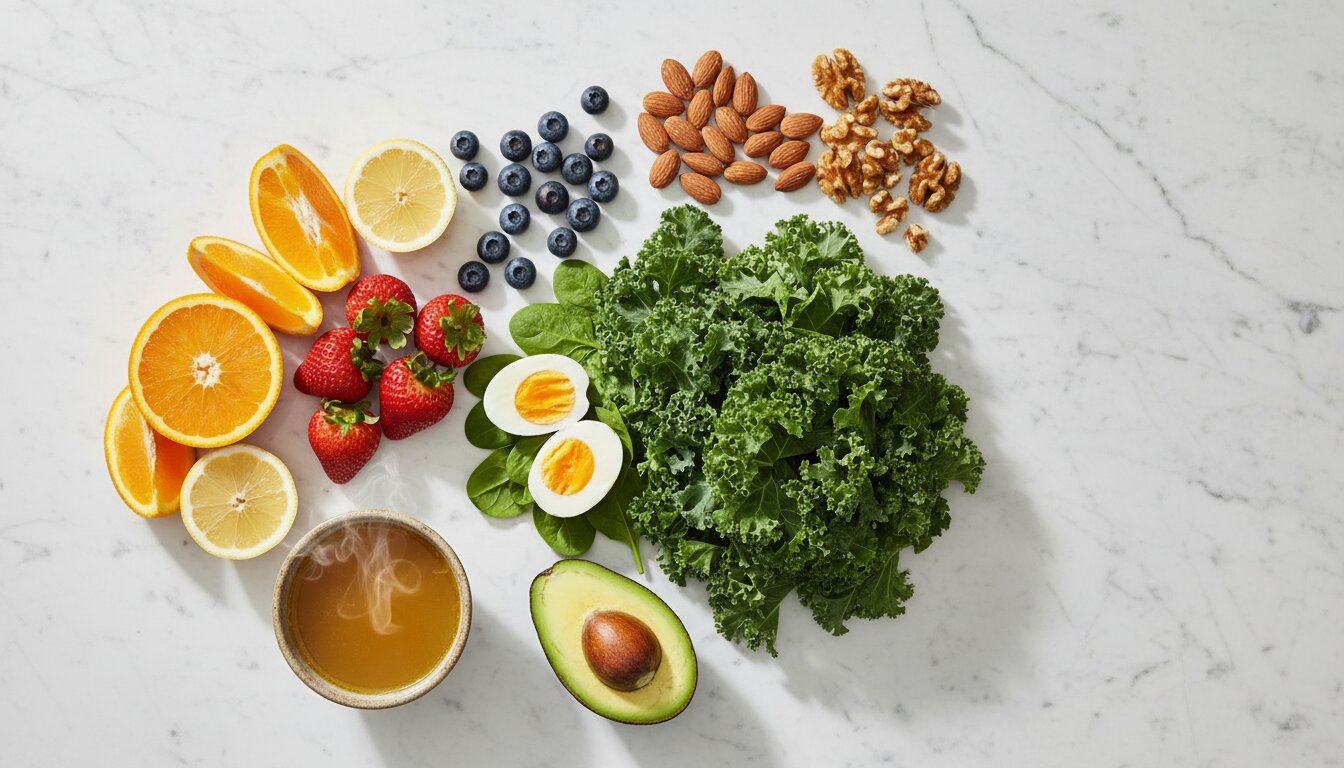
Even more important than eating collagen directly is giving your body the nutrients it needs to produce its own collagen. These foods don’t contain collagen themselves — but they provide the essential cofactors your body requires for collagen synthesis:
Vitamin C-rich foods
Vitamin C is absolutely essential for collagen production. Without it, your body cannot form new collagen fibres — full stop. The best food sources include:
- Citrus fruits — oranges, lemons, grapefruits
- Berries — strawberries, blackcurrants, blueberries
- Bell peppers — particularly red peppers, which have more vitamin C per gram than oranges
- Kiwi — one of the most vitamin C-dense fruits available
- Broccoli and kale — green vegetables are an underrated source
Zinc-rich foods
Zinc acts as a cofactor in collagen synthesis and supports skin repair and immune function. Good sources include:
- Pumpkin seeds — one of the best plant sources of zinc
- Shellfish — oysters, prawns, crab
- Nuts — cashews, almonds
- Eggs — also provide proline, an amino acid essential for collagen
- Chickpeas and lentils — a good option for plant-based diets
Proline and glycine-rich foods
Proline and glycine are the two most important amino acids for collagen production. You’ll find them in:
- Eggs — particularly the whites, which are rich in proline
- Dairy — cheese and yoghurt provide proline
- Mushrooms — a surprisingly good source of proline
- Soya — tofu and tempeh
- Gelatin — essentially cooked collagen, found in jellies and some desserts
Other supportive foods
- Oily fish — salmon, mackerel, sardines. The omega-3s support skin health and a healthy inflammatory response, which protects existing collagen from breaking down too quickly.
- Leafy greens — spinach, kale, and Swiss chard contain chlorophyll, which some research suggests may support collagen production.
- Tomatoes — rich in lycopene, an antioxidant that helps protect collagen from UV damage.
- Garlic — contains sulphur, which is involved in collagen synthesis and may help prevent collagen breakdown.
Can You Get Enough Collagen From Food Alone?
Here’s where it gets practical. The research that shows real, measurable benefits for skin, joints, and overall wellness consistently uses doses of 10,000–15,000mg of hydrolysed collagen per day.
To get that from food, you’d need to consume something like:
- 2–3 large bowls of bone broth daily, or
- Multiple servings of chicken skin and connective tissue, or
- A significant amount of pork rind or fish skin
That’s simply not practical for everyday eating. And even if you did manage it, there’s a second challenge: absorption.
The collagen in whole foods is in its native, triple-helix form — large, complex molecules that your digestive system has to work hard to break apart. Not all of it gets broken down efficiently, which means not all of it reaches your bloodstream in a form your body can use for collagen synthesis.
Hydrolysed collagen in supplements has already been broken down into small peptide chains — typically 2,000–5,000 daltons — that your body absorbs quickly and efficiently. Studies show that hydrolysed collagen peptides reach your bloodstream within about 20 minutes of consumption.
For a full breakdown of what the research says about effective doses, our collagen dosage guide covers everything.
Foods That Damage Collagen
While some foods support collagen, others actively work against it. Being aware of these can help you protect the collagen your body already has:
- Sugar and refined carbohydrates — excess sugar triggers a process called glycation, which damages collagen fibres and makes them stiff and fragile. This is one of the mechanisms behind sugar-related skin ageing.
- Excessive alcohol — alcohol dehydrates your skin, depletes nutrients (including vitamin C and zinc), and can increase inflammation — all of which accelerate collagen breakdown.
- Processed and ultra-processed foods — high in inflammatory compounds that can damage existing collagen and slow the production of new collagen.
- Charred or blackened foods — the advanced glycation end products (AGEs) formed during high-heat cooking can damage collagen fibres.
This isn’t about being perfect — it’s about being aware. A balanced diet that’s rich in whole foods and doesn’t rely heavily on sugar and processed ingredients gives your collagen the best chance of lasting.
The Best of Both: Food + Supplementation
The smartest approach to collagen isn’t choosing between food and supplements — it’s combining both:
- Eat collagen-supportive foods daily — plenty of vitamin C-rich fruits and vegetables, zinc-rich nuts and seeds, and proline from eggs and dairy. These give your body the cofactors it needs for collagen synthesis.
- Supplement with hydrolysed collagen — to hit the 10,000–15,000mg daily dose that research links to real results. One serving, one drink, done.
- Minimise collagen-damaging habits — moderate sugar, protect your skin from excessive sun exposure, stay hydrated.
Think of it this way: food provides the supporting environment, and supplementation provides the building materials. Together, they give your body the best possible conditions for maintaining healthy, resilient collagen throughout your skin, joints, gut, and beyond.
What About Vegan Collagen?
There is no plant-based source of collagen. Collagen is an animal protein — it’s found in the connective tissue of animals and fish, not in plants.
What you can do on a plant-based diet is support your body’s own collagen production by eating plenty of vitamin C, zinc, copper, and amino acid-rich plant proteins (like soya, quinoa, and legumes). Some supplements marketed as “vegan collagen” or “collagen boosters” contain these supportive nutrients — but they don’t provide collagen itself.
For women who eat animal products and want to directly supplement their collagen intake, bovine collagen provides the broadest support. Our bovine vs marine collagen guide explains why bovine’s combination of Type I and Type III collagen covers more bases than marine collagen’s Type I alone.
Making It Simple
Collagen from food is a valuable part of a healthy diet — but it’s very difficult to get a meaningful, consistent dose from food alone. The most practical approach is to eat well, include collagen-supportive nutrients in your diet, and top up with a daily collagen supplement that delivers an effective dose in one go.
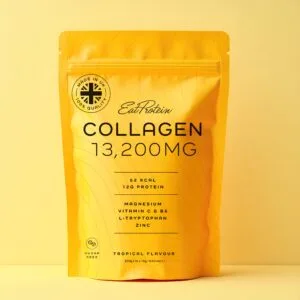
EatProtein’s Rejuvenating Collagen Tropical Juice delivers 13,200mg of hydrolysed bovine collagen per serving — with added Vitamin C, Zinc, B6, and Magnesium built in. No need to calculate, no need to eat three bowls of bone broth. Just one refreshing daily drink that gives your body exactly what it needs.
Ready to give your body the collagen support it deserves? Explore our collagen range and find your new daily essential.
References
- Alcock, R. D., Shaw, G. C., Tee, N., & Burke, L. M. (2019). Bone Broth Unlikely to Provide Reliable Concentrations of Collagen Precursors Compared With Supplemental Sources of Collagen Used in Collagen Research. International Journal of Sport Nutrition and Exercise Metabolism. View source
- Harvard T.H. Chan School of Public Health. (2023). Collagen. The Nutrition Source. View source
- Pullar, J. M., Carr, A. C., & Vissers, M. C. M. (2017). The Roles of Vitamin C in Skin Health. Nutrients. View source
- Gkogkolou, P., & Böhm, M. (2012). Advanced glycation end products: Key players in skin aging? Dermato-Endocrinology. View source
- Danby, F. W. (2010). Nutrition and aging skin: sugar and glycation. Clinics in Dermatology. View source
- Proksch, E., Segger, D., Degwert, J., Schunck, M., Zague, V., & Oesser, S. (2014). Oral supplementation of specific collagen peptides has beneficial effects on human skin physiology: a double-blind, placebo-controlled study. Skin Pharmacology and Physiology. View source
- Shoulders, M. D., & Raines, R. T. (2009). Collagen Structure and Stability. Annual Review of Biochemistry. View source