You can invest in the best skincare routine, the most nourishing hair masks, and every nail strengthener on the shelf — but if you’re not supporting your skin, hair, and nails from the inside, you’re only working on half the picture.
That’s not a sales pitch. It’s biology. Your skin, hair, and nails are built from protein — specifically, from collagen and keratin. And what your body has available internally directly affects how they look and feel on the outside.
Here’s what actually happens when you give your body the collagen it needs, and why so many women are making it part of their daily routine.
Why Your Skin Needs Collagen
Collagen isn’t just in your skin — it essentially is your skin. Type I collagen makes up around 80% of your skin’s structure. It’s the protein responsible for firmness, elasticity, and that plump, hydrated look that no amount of topical serum can fully replicate.
Here’s what’s happening beneath the surface:
- Elasticity — collagen fibres give your skin its ability to stretch and bounce back. When collagen declines, skin loses that resilience and fine lines become more visible.
- Hydration — collagen helps your skin retain moisture at a structural level. Well-hydrated skin looks smoother, feels softer, and has that healthy glow that comes from genuine nourishment.
- Firmness — the collagen matrix acts as scaffolding for your skin. As that scaffolding weakens, skin starts to lose its structure — particularly around the jawline, cheeks, and neck.
From your mid-twenties, your body’s collagen production starts to slow — by roughly 1–1.5% per year. By your forties, that decline accelerates, and the visible signs become harder to ignore. Supplementing with collagen gives your body the raw materials to maintain what it’s naturally losing.
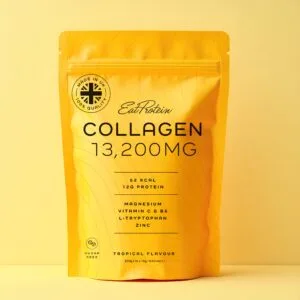
EatProtein’s Rejuvenating Collagen delivers 13,200mg of hydrolysed bovine collagen per serving — providing both Type I (the dominant collagen in your skin) and Type III (which supports the deeper structural layers). It’s the inside-out approach to skin that actually works.
What the Research Says About Collagen and Skin
This isn’t wishful thinking — there’s strong clinical evidence behind collagen supplementation for skin health:
- Improved elasticity — studies show that women taking 10,000mg+ of hydrolysed collagen daily saw measurable improvements in skin elasticity within 4–8 weeks.
- Reduced fine lines — research has found that consistent collagen supplementation can reduce the depth of wrinkles and fine lines, particularly around the eyes.
- Better hydration — clinical trials report significant improvements in skin moisture levels, with participants describing their skin as softer, smoother, and more supple.
- Increased skin density — collagen peptides have been shown to stimulate fibroblasts (the cells that produce new collagen), helping to rebuild the skin’s structural matrix from within.
The consistent finding across studies: dose and consistency matter. Lower doses can help, but the most impressive results come from 10,000–15,000mg daily, taken every day without skipping. For a full breakdown of what the research says about dosage, our collagen dosage guide has the details.
Collagen for Hair: More Than Just Skin Deep
Your hair is made of keratin — a structural protein — and collagen plays a supporting role in hair health that’s often underestimated.
How collagen supports your hair
- Amino acid supply — your body uses the amino acids from collagen (particularly proline) to build keratin. More available proline means more building blocks for strong, healthy hair.
- Follicle nourishment — the dermis layer of your scalp, where hair follicles are rooted, is rich in collagen. Maintaining that collagen helps create a healthy environment for hair growth.
- Antioxidant protection — some of the amino acids in collagen, particularly glycine, have antioxidant properties that may help protect hair follicles from damage.
- Scalp health — because collagen supports skin hydration and structure, it also supports the health of your scalp — the foundation everything grows from.
Many women notice their hair feels thicker, stronger, and less prone to breakage after 8–12 weeks of daily collagen supplementation. It’s not a dramatic overnight change — it’s a gradual improvement that builds with consistency.
Hair thinning and collagen decline
Hair thinning is one of the most common concerns women have, particularly from their late thirties onwards. It’s often linked to the same collagen decline that affects skin — your scalp’s dermis layer loses structural support, and hair follicles become less robust as a result.
Supplementing with collagen won’t reverse genetic hair loss, but it can support the health and thickness of the hair you have — giving your follicles the nourishment they need to produce stronger, more resilient strands.
Collagen for Stronger Nails
If your nails are brittle, peeling, or just won’t seem to grow, collagen might be the missing piece.
Your nails, like your hair, are made of keratin. And the nail bed they grow from is rich in collagen-dependent tissue. When your body has enough collagen to maintain that tissue, your nails tend to grow faster, stronger, and with less splitting.
Research supports this too — one clinical study found that women taking collagen peptides daily experienced a 12% increase in nail growth rate and a 42% reduction in broken nails after 24 weeks. Those are meaningful numbers for anyone who’s struggled with weak, frustrating nails.
Bovine vs Marine: Which Is Better for Beauty?
Both bovine and marine collagen contain Type I — the collagen that dominates your skin, hair, and nails. So both can support your beauty goals.
But bovine collagen has an advantage: it also provides Type III collagen, which supports the deeper structural layers of your skin and the connective tissue beneath the surface. Type III works alongside Type I to maintain skin’s overall architecture — not just the surface, but the foundation.
Marine collagen delivers Type I only. It’s effective for skin, but it’s a narrower approach. For a deeper comparison, our bovine vs marine collagen guide breaks down exactly what each source offers.
The Supporting Cast: Nutrients That Help Collagen Work
Collagen doesn’t work alone. Several nutrients play essential roles in how your body uses collagen peptides to build and maintain skin, hair, and nails:
- Vitamin C — absolutely essential for collagen synthesis. Without adequate vitamin C, your body literally cannot form new collagen fibres. It’s non-negotiable.
- Zinc — supports skin repair, immune function, and the structural integrity of your hair and nails. Zinc deficiency is actually linked to hair loss and slow wound healing.
- L-Tryptophan — an essential amino acid that supports serotonin production, which influences sleep quality. And quality sleep is when your body does its most intensive repair and renewal work — including building new collagen.
- Vitamin B6 — supports amino acid metabolism, helping your body make the most of every gram of collagen protein you take in.
- Magnesium — involved in protein synthesis and energy production. Supports the cellular processes that maintain healthy skin and hair.
This is worth checking when you choose a collagen supplement. A formula that includes these cofactors means you’re not just taking collagen — you’re giving your body everything it needs to actually use it.
EatProtein’s Rejuvenating Collagen includes Vitamin C, Zinc, Vitamin B6, Magnesium, and added L-Tryptophan — making it one of the most complete collagen formulas available. No need for a separate vitamin stack.
The Gut-Skin Connection
Here’s something most beauty-focused collagen articles don’t mention: your gut health directly affects how your skin looks.
A well-functioning digestive system absorbs nutrients more efficiently — including the collagen peptides you’re supplementing with. An inflamed or compromised gut lining, on the other hand, can lead to poor nutrient absorption, inflammation that shows up on your skin, and that dull, tired look that no skincare product can fix.
Type III collagen — found in bovine collagen — supports the lining of your gut. So when you take bovine collagen for your skin, you’re also supporting the gut health that makes better skin possible. It’s a genuinely complementary relationship.
For a deeper dive into how your digestion affects your skin, our gut-skin connection guide covers the full picture.
How Much Collagen for Skin, Hair, and Nails?
Based on the clinical research, here’s what to aim for:
- For skin benefits — 10,000–15,000mg daily delivers the most consistent results in studies. Lower doses (2,500–5,000mg) can help, but results are slower and more subtle.
- For hair and nails — the same dose range applies. Since hair and nails are built from the same amino acid building blocks, a dose that supports skin will support them too.
- Timeline — expect to notice skin hydration and texture improvements within 4–8 weeks. Hair thickness and nail strength typically take 8–12 weeks.
For a complete guide to dosage — including timing, format, and how long to give it — read our full dosage guide.
What About Topical Collagen?
You’ll find collagen in plenty of creams, serums, and masks. And while they can support surface-level hydration, there’s an important limitation: collagen molecules are too large to penetrate the deeper layers of your skin when applied topically.
Topical products sit on the surface. They can moisturise and create a temporary plumping effect — and that’s genuinely useful — but they can’t rebuild the structural collagen matrix that gives skin its long-term firmness and elasticity.
That’s why supplementation works differently. Hydrolysed collagen peptides are absorbed through your digestive system and delivered to your skin via your bloodstream — reaching the dermis layer where collagen production actually happens. It’s inside-out support that topical products simply can’t replicate.
The best approach? Both. Use your favourite skincare for surface-level hydration and protection, and supplement with collagen to rebuild from within.
Collagen and Ageing: What You Can Realistically Expect
Let’s be honest about what collagen can and can’t do:
- It won’t turn back the clock — collagen supports your skin’s natural structure and slows visible decline, but it’s not a replacement for the collagen you produced at 21.
- It supports graceful ageing — firmer skin, better hydration, fewer fine lines, stronger hair and nails. These are real, measurable benefits that help you look and feel your best at every stage.
- Results build over time — this isn’t an overnight transformation. It’s a gradual, cumulative improvement that comes from daily consistency.
For women navigating perimenopause, collagen decline accelerates as oestrogen levels drop. Supplementing during this stage can make a particularly noticeable difference. Our collagen and menopause guide covers what to expect and how to support your body through this transition.
Making Collagen Part of Your Beauty Routine
The simplest approach is the best one:
- One serving daily — consistency is everything. Make it a non-negotiable part of your morning.
- Choose a dose that works — 10,000mg+ per serving to get meaningful beauty benefits without thinking about it.
- Look for cofactors — Vitamin C, Zinc, and a complete amino acid profile make a real difference to how well your body uses the collagen.
- Give it 8–12 weeks — take a photo on day one. You’ll be glad you did.
EatProtein’s Rejuvenating Collagen Tropical Juice delivers 13,200mg of hydrolysed bovine collagen per serving with all nine essential amino acids, Vitamin C, B6, Zinc, and Magnesium — a complete beauty-from-within formula in a refreshing daily drink that takes seconds to make.
Ready to support your skin, hair, and nails from the inside out? Explore our collagen range and start your glow-from-within journey.
References
- Proksch, E., Schunck, M., Zague, V., Segger, D., Degwert, J., & Oesser, S. (2014). Oral intake of specific bioactive collagen peptides reduces skin wrinkles and increases dermal matrix synthesis. Skin Pharmacology and Physiology. View source
- Evans, M., Lewis, E. D., Zakaria, N., Pelipyagina, T., & Guthrie, N. (2021). A randomized, triple-blind, placebo-controlled, parallel study to evaluate the efficacy of a freshwater marine collagen on skin wrinkles and elasticity. Journal of Cosmetic Dermatology. View source
- Hexsel, D., Zague, V., Schunck, M., Siega, C., Camozzato, F. O., & Oesser, S. (2017). Oral supplementation with specific bioactive collagen peptides improves nail growth and reduces symptoms of brittle nails. Journal of Cosmetic Dermatology. View source
- Choi, F. D., Sung, C. T., Juhasz, M. L. W., & Mesinkovska, N. A. (2019). Oral Collagen Supplementation: A Systematic Review of Dermatological Applications. Journal of Drugs in Dermatology. View source
- Reilly, D. M., & Lozano, J. (2021). Skin collagen through the lifestages: importance for skin health and beauty. Plastic and Aesthetic Research. View source
- Pullar, J. M., Carr, A. C., & Vissers, M. C. M. (2017). The Roles of Vitamin C in Skin Health. Nutrients. View source
- Asserin, J., Lati, E., Shioya, T., & Prawitt, J. (2015). The effect of oral collagen peptide supplementation on skin moisture and the dermal collagen network: evidence from an ex vivo model and randomized, placebo-controlled clinical trials. Journal of Cosmetic Dermatology. View source