Menopause changes a lot of things. Some of those changes are expected — the hot flushes, the mood shifts, the sleep disruptions. But others catch women completely off guard: the sudden joint stiffness, the skin that seems to age overnight, the hair that feels thinner, the bloating that appears from nowhere.
What most women don’t realise is that many of these changes share a common thread: collagen decline.
Your body’s collagen production doesn’t just slow gradually through menopause — it drops sharply. And that accelerated decline shows up in ways you might not connect to collagen at all. Here’s what’s really happening, and what you can do about it.
Why Menopause Accelerates Collagen Loss
Collagen production naturally declines from your mid-twenties — roughly 1–1.5% per year. But during menopause, that decline goes into overdrive.
The reason is oestrogen. Oestrogen plays a significant role in stimulating collagen production. As oestrogen levels drop during perimenopause and menopause, your body’s ability to produce new collagen drops with it.
The numbers are striking: women can lose up to 30% of their skin collagen in the first five years after menopause begins. After that, the decline continues at around 2% per year.
That’s not just a skin issue. Collagen is the structural protein in your joints, gut lining, bones, hair follicles, and nails. When production drops this dramatically, the effects show up everywhere.
Menopause Joint Pain: The Collagen Connection
If your knees have started grumbling, your hips feel tighter than they used to, or your fingers are stiff first thing in the morning — you’re not imagining it. Joint pain is one of the most common menopause symptoms, affecting up to 50% of menopausal women.
Here’s what’s happening:
- Oestrogen protects your joints — it has natural anti-inflammatory properties and supports the health of cartilage, tendons, and ligaments. As levels drop, that protection fades.
- Cartilage thins — without adequate collagen renewal, the cartilage cushioning your joints becomes less resilient. Movements that felt easy can start to feel uncomfortable.
- Connective tissue weakens — tendons and ligaments rely on Types I and III collagen for their strength and flexibility. Declining production means they become stiffer and less supportive.
- Inflammation increases — reduced oestrogen can trigger a shift in your body’s inflammatory response, making joints feel more sensitive and reactive.
Supplementing with collagen provides the amino acids — glycine, proline, and hydroxyproline — that your body uses to maintain and repair joint tissue. It’s not a replacement for oestrogen, but it directly supports the structures that oestrogen used to help protect.
For a deeper look at how collagen supports your joints specifically, our collagen for joint health guide covers the research, the types, and how long it takes to notice a difference.
Research shows that 5,000–15,000mg of hydrolysed collagen daily can improve joint comfort and flexibility within 8–12 weeks. For menopausal women, aiming for the higher end of that range — 10,000mg+ — gives your body more building blocks to work with during a time of accelerated decline.
Skin Changes During Menopause
The skin changes during menopause can feel sudden and frustrating. What was working for your skin six months ago suddenly isn’t enough. And it’s not your skincare routine’s fault — it’s what’s happening underneath.
Sagging and loss of firmness
With up to 30% of your skin’s collagen disappearing in those first few years, the structural scaffolding that keeps skin firm starts to weaken. This is most noticeable around the jawline, cheeks, and neck — areas where gravity has the most impact.
Dryness and dehydration
Collagen helps your skin retain moisture at a structural level. Less collagen means less moisture retention, which leads to skin that feels dry, rough, or tight — even when you’re using the same moisturisers you’ve always used.
Itchy skin
This one surprises a lot of women. Itchy skin during menopause is more common than most people realise, and it’s often linked to the combination of collagen decline and reduced natural oil production. When your skin’s barrier weakens, it becomes more reactive and prone to irritation.
Supplementing with collagen supports the structural integrity and hydration of your skin from within — addressing the root cause rather than just the surface symptoms. For the full picture on collagen and skin health, our collagen for skin, hair and nails guide goes into the detail.
Fine lines and wrinkles
The accelerated collagen loss during menopause means fine lines can deepen quickly. It’s not that ageing is wrong or something to fight against — but supporting your body’s ability to maintain its natural collagen helps you feel comfortable and confident in your skin at every stage.
Hair Thinning and Nail Changes
Thinning hair is one of the most emotionally difficult menopause symptoms — and one that rarely gets the attention it deserves. Your hair follicles sit in the dermis layer of your scalp, which is rich in collagen. As that collagen declines, the environment your hair grows from becomes less supportive.
The result: hair that feels finer, less dense, and more prone to breakage. It’s not dramatic hair loss for most women — it’s a gradual change in texture and thickness that can feel disheartening.
Similarly, nails can become brittle, slow-growing, and prone to splitting during menopause. The nail bed relies on collagen-rich tissue, and when that tissue weakens, your nails feel the effect.
Collagen supplementation provides the amino acids your body uses to build keratin (the protein in hair and nails) and maintain the structural tissue that supports healthy growth.
Bloating and Gut Health During Menopause
Bloating during menopause is incredibly common — and incredibly frustrating. Hormonal shifts affect your digestive system in several ways: gut motility can slow, the gut microbiome can shift, and the gut lining itself can become more permeable.
This is where Type III collagen — found in bovine collagen — plays a particularly important role. Type III supports the structural integrity of your gut lining. A stronger, healthier gut lining means:
- Better nutrient absorption — your body gets more benefit from the food and supplements you’re taking
- Reduced bloating — a well-functioning gut is less prone to the gas and discomfort that causes bloating
- More comfortable digestion — supporting the gut lining helps your digestive system work with you rather than against you
If bloating is something you deal with regularly, our gut health guide explores the most common causes and practical solutions — including the role your gut lining plays.

Body Composition Changes
Many women notice their body composition shifts during menopause — even when their diet and activity levels haven’t changed. Hormonal changes affect how your body stores and distributes weight, and declining collagen affects the lean tissue (muscle support structures, connective tissue) that influences your metabolism.
Collagen isn’t a weight loss supplement — no supplement is. But it does support lean body composition in meaningful ways:
- Protein for satiety — at 12g of protein and just 52 calories per serving, collagen helps you feel satisfied without adding significant calories
- Connective tissue support — maintaining the tendons and ligaments that support your muscles helps your body function efficiently
- Supporting an active lifestyle — comfortable joints mean you can stay active in the ways that feel good to you
Our collagen and weight management guide explores the relationship between collagen, protein, and body composition in more detail.
The Nutrients That Matter More During Menopause
Collagen is one piece of the puzzle. During menopause, your body’s needs shift — and several nutrients become even more important:
- Vitamin C — essential for collagen synthesis. Without it, your body can’t form new collagen fibres no matter how much collagen you take.
- Magnesium — supports muscle relaxation, energy production, and sleep quality — all areas that can be disrupted during menopause. Many women are deficient without realising it.
- Zinc — supports immune function, skin repair, and hormone balance. Research links zinc deficiency to slower wound healing and weaker hair.
- Vitamin B6 — supports amino acid metabolism, energy, and mood regulation. It helps your body make the most of the protein and amino acids in your collagen.
- L-Tryptophan — an essential amino acid that supports serotonin production, which influences mood and sleep. Both are commonly disrupted during menopause.
A good collagen supplement should include these cofactors so you’re not piecing together a separate vitamin stack on top of everything else. For a broader look at supplements worth considering during this stage, our perimenopause supplements guide covers the full picture.
How Much Collagen During Menopause?
Given the accelerated rate of collagen loss during menopause, dosage matters even more during this stage:
- 10,000–15,000mg daily — this is the range supported by the strongest research for skin, joints, and overall connective tissue support. During menopause, when your body is losing collagen faster than at any other time, a higher dose gives it more to work with.
- Consistency is essential — daily supplementation provides a steady supply of amino acids for ongoing maintenance and repair. Skipping days means your body has less building material during a time it needs it most.
- Give it 8–12 weeks — real changes take time, particularly for joints and hair. Skin hydration improvements often appear sooner, within 4–8 weeks.
For the complete dosage breakdown — including timing, format, and what to look for — our collagen dosage guide has everything you need.
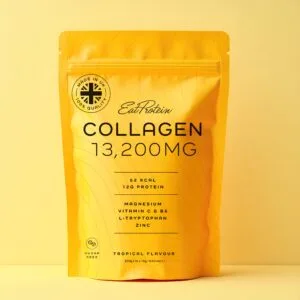
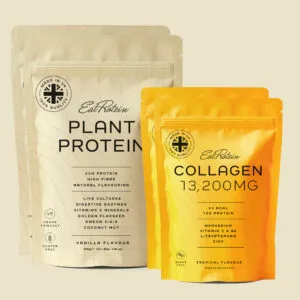
EatProtein’s Rejuvenating Collagen delivers 13,200mg of hydrolysed bovine collagen per serving — right in the sweet spot for menopausal support — with added Vitamin C, B6, Zinc, Magnesium, and all nine essential amino acids including L-Tryptophan.
Bovine Collagen: Why It’s the Better Choice During Menopause
During menopause, your body needs support across multiple areas simultaneously — skin, joints, gut, hair, nails. That’s why the type of collagen you choose matters.
Bovine collagen provides both Type I and Type III — covering skin elasticity, joint support, and gut health in one supplement. Marine collagen provides only Type I, which limits its scope to skin-focused benefits.
For women navigating menopause, where the effects of collagen decline are showing up everywhere at once, bovine collagen’s broader profile makes it the more practical choice. Our bovine vs marine collagen comparison breaks down the differences in detail.
Supporting Your Body Through the Transition
Menopause isn’t something to fix — it’s a natural transition. But that doesn’t mean you have to accept every symptom without support. Giving your body the nutrition it needs to maintain its structure, comfort, and vitality during this stage is one of the simplest, most empowering things you can do.
- Take collagen daily — one serving, every day, to offset the accelerated decline
- Stay active — movement keeps joints lubricated, muscles strong, and mood balanced
- Prioritise sleep — your body does its repair work while you rest. L-Tryptophan and magnesium both support better sleep quality.
- Be patient with yourself — changes take time. Trust the process and focus on how you feel, not just how you look.
EatProtein’s Rejuvenating Collagen Tropical Juice delivers 13,200mg of hydrolysed bovine collagen with all nine essential amino acids, Vitamin C, B6, Zinc, and Magnesium — everything your body needs in one refreshing daily drink. It’s whole-body support for a time when your body deserves it most.
Ready to support your body through menopause? Explore our collagen range and give yourself the nourishment you deserve.
References
- Brincat, M. P. (2000). Hormone replacement therapy and the skin. Maturitas. View source
- Thornton, M. J. (2013). Estrogens and aging skin. Dermato-Endocrinology. View source
- Mesinkovska, N. A. (2023). Skin aging and menopause: implications for treatment. American Journal of Clinical Dermatology. View source
- Calleja-Agius, J., & Brincat, M. P. (2012). The effect of menopause on the skin and other connective tissues. Gynecological Endocrinology. View source
- Taşkın, S., Yüksel, Ş. B., Çağlar, M., & Altınyurt, S. (2016). Estrogen, menopause and joints. Climacteric. View source
- Levin, A. D., & Keshet, D. (2018). Musculoskeletal pain and menopause. Post Reproductive Health. View source
- König, D., Oesser, S., Scharla, S., Zdzieblik, D., & Gollhofer, A. (2018). Specific Collagen Peptides Improve Bone Mineral Density and Bone Markers in Postmenopausal Women. Nutrients. View source