If you’ve started looking into collagen supplements, you’ve probably hit the same fork in the road everyone does: bovine or marine? One comes from grass-fed cattle, the other from fish — and both promise glowing skin, stronger joints, and all-round wellness support. So how do you choose?
The short answer: it depends on what you’re looking for. But when you compare what each source actually delivers — the collagen types, the amino acid profile, the breadth of benefits — one comes out ahead for women who want comprehensive, everyday support.
Let’s break it down honestly.
What Is Collagen, and Why Does the Source Matter?
Collagen is the most abundant protein in your body. It’s the structural framework behind your skin’s firmness, the flexibility in your joints, the strength in your hair and nails, and even the lining of your gut. Your body produces it naturally — but from your mid-twenties, that production starts to slow.
That’s where supplements come in. But not all collagen is created equal. The source determines which types of collagen you’re getting, and different types do different things in your body. Choosing the right source means you’re supporting the areas that matter most to you.
Bovine Collagen: Types I and III
Bovine collagen is sourced from cattle — typically from the hide and connective tissue. Once hydrolysed (broken into smaller peptides your body can absorb easily), it delivers two key types:
- Type I — the most abundant collagen in your body, found in skin, hair, nails, bones, and tendons. This is the one most associated with skin elasticity and that healthy, hydrated glow.
- Type III — found in skin, blood vessels, and your gut lining. It works alongside Type I to support skin structure and intestinal health.
Together, Types I and III cover a wide range of your body’s collagen needs — from how your skin looks and feels to how your joints and gut function day to day.
Research suggests that supplementing with bovine collagen may also support your body’s own production of Type II collagen — the type found in cartilage. That means you’re not just getting two types; you could be encouraging a third.
Marine Collagen: Type I Only
Marine collagen comes from fish — usually the skin and scales. It’s hydrolysed in the same way as bovine, breaking down into peptides that are easy to absorb.
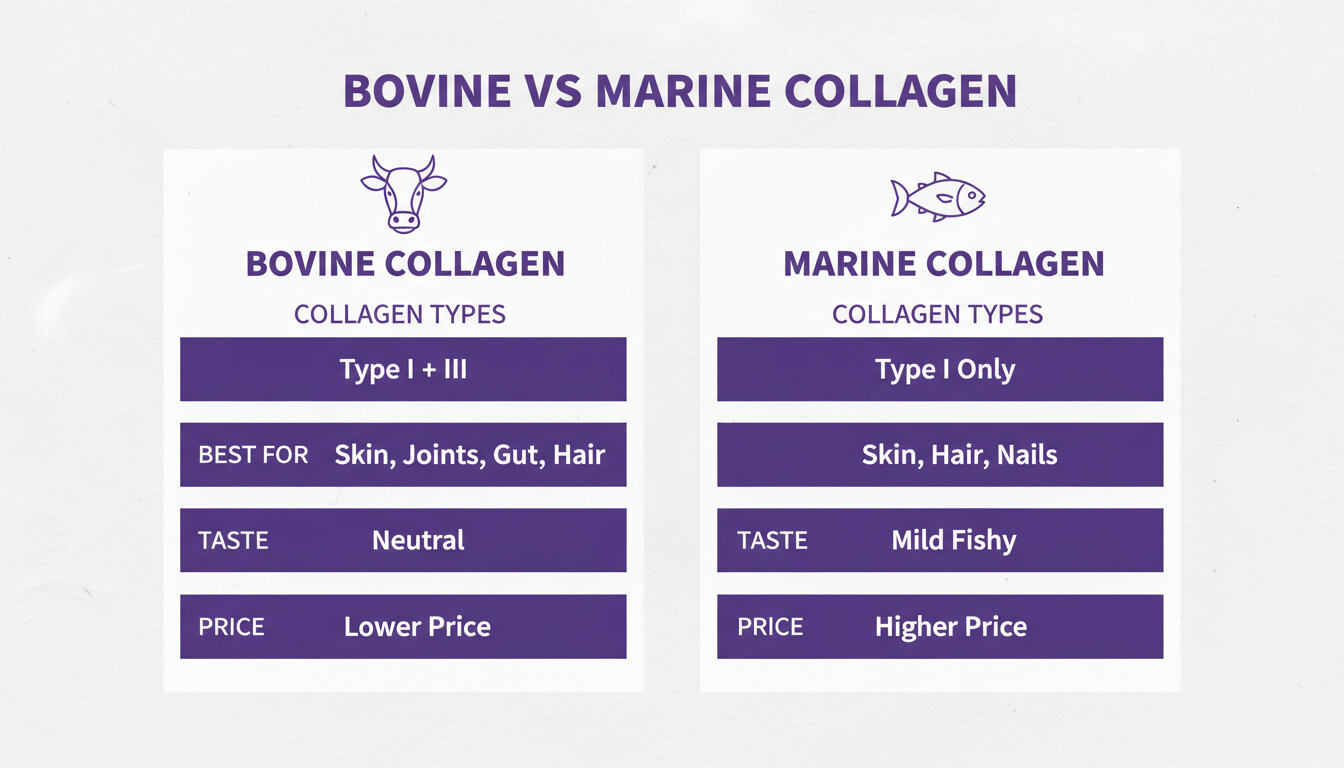
The key difference? Marine collagen contains only Type I. That makes it effective for skin-focused benefits — elasticity, hydration, fine lines — but it doesn’t deliver the Type III support for gut health and broader connective tissue that bovine provides.
Marine collagen is a solid option if skin is your sole focus. But if you’re looking for all-round wellness support — skin, joints, gut, hair, nails — it’s a narrower choice.
Amino Acid Profile: The Hidden Difference
Both bovine and marine collagen are rich in the amino acids your body uses to build and repair connective tissue — particularly glycine, proline, and hydroxyproline. These three are the backbone of collagen synthesis.
Where things get interesting is the breadth of the amino acid profile. Bovine collagen naturally contains a wider spread of amino acids. And when a formula is designed to include all nine essential amino acids — the ones your body can’t make on its own — you’re getting a genuinely complete protein, not just a collagen supplement.
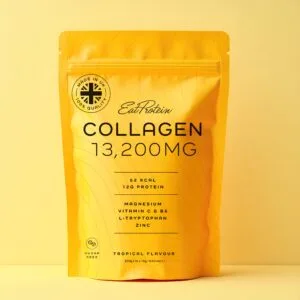
EatProtein’s Rejuvenating Collagen includes added L-Tryptophan to deliver all nine essential amino acids — something most collagen supplements (bovine or marine) don’t offer.
That matters because L-Tryptophan supports serotonin production, which plays a role in mood, sleep, and overall wellbeing. It’s a thoughtful addition that turns a collagen powder into something more complete.
Absorption: Is One Faster Than the Other?
You’ll sometimes hear that marine collagen has smaller peptides and absorbs faster. There’s a grain of truth here — some marine collagen peptides do have a slightly lower molecular weight — but in practice, both bovine and marine collagen are hydrolysed to a similar degree. Modern hydrolysed bovine collagen is absorbed efficiently, with peptides reaching your bloodstream within around 20 minutes.
The difference in absorption between the two is marginal. What matters more is how much you’re taking and how consistently you take it.
Benefits: A Side-by-Side Look
Here’s how the two sources compare across the areas women care about most:
- Skin elasticity and hydration — both deliver Type I collagen, so both support skin health. Bovine adds Type III for deeper structural support.
- Hair and nails — both help. Type I collagen is the key player here, and you’ll find it in both sources.
- Joint support — bovine has the edge. Types I and III support tendons and ligaments, and bovine may encourage your body’s own Type II production for cartilage.
- Gut health — bovine wins. Type III collagen supports the gut lining, making it a better choice if digestive comfort is a priority. If you’re curious about the link between gut health and how you look and feel, our gut-skin connection guide goes deeper.
- Overall wellness — bovine’s broader collagen profile (I + III, with potential Type II support) makes it the more versatile daily supplement.
Sustainability and Sourcing
Both bovine and marine collagen can be responsibly sourced. Bovine collagen is typically a by-product of the meat industry — using parts that would otherwise go to waste. Marine collagen uses fish skin and scales, also by-products of the fishing industry.
Neither source is suitable for vegetarians or vegans. If you follow a plant-based diet, collagen-supporting nutrients like vitamin C, zinc, and amino acids from plant proteins can help your body maintain its own collagen production — though they don’t provide collagen directly.
Taste and Mixability
One practical difference worth mentioning: marine collagen can carry a slight fishy taste or smell, even in flavoured formulas. It’s subtle, but it’s there — and for some people, it’s a dealbreaker.
Bovine collagen is naturally more neutral. When it’s flavoured well — like a tropical juice you’d actually look forward to drinking — it fits into your morning routine without any compromise on taste.
Price: Getting More for Your Money
Marine collagen typically costs more than bovine, partly because of sourcing and processing costs. Bovine collagen delivers a broader range of benefits at a lower price point — which means better value per serving, especially when you’re taking it daily over weeks and months.
Given that consistency is the single biggest factor in seeing results, choosing a collagen you can afford to take every day matters more than chasing marginal differences in absorption speed.
So Which Should You Choose?
If you’re after skin-only support and have a strong preference for a fish-derived source, marine collagen will do the job.
But if you want comprehensive, whole-body support — skin, hair, nails, joints, and gut health — bovine collagen is the smarter choice. It delivers more collagen types, a broader amino acid profile, better value, and a more neutral taste.
For women who want to support their wellness from the inside out — not just one area, but the full picture — bovine collagen is the foundation that covers it all.
What to Look for in a Bovine Collagen Supplement
Not all bovine collagen supplements are equal. Here’s what separates a good one from a great one:
- Hydrolysed peptides — ensures fast, efficient absorption
- A meaningful daily dose — look for 10,000mg or more per serving. Research consistently links higher doses to better results.
- Added vitamins and minerals — Vitamin C is essential for collagen synthesis; zinc and magnesium support skin, energy, and recovery.
- A complete amino acid profile — nine essential amino acids means you’re getting a complete protein, not just collagen.
- Something you’ll actually enjoy taking — taste matters when you’re building a daily habit.
EatProtein’s Rejuvenating Collagen Tropical Juice ticks every one of those boxes: 13,200mg of hydrolysed bovine collagen per serving, all nine essential amino acids, added Vitamin C, B6, Zinc, and Magnesium — in a refreshing tropical drink that takes seconds to make.
Ready to give your body the complete collagen support it deserves? Explore our collagen range and find your new daily ritual.
References
- Proksch, E., Schunck, M., Zague, V., Segger, D., Degwert, J., & Oesser, S. (2014). Oral intake of specific bioactive collagen peptides reduces skin wrinkles and increases dermal matrix synthesis. Skin Pharmacology and Physiology. View source
- Sibilla, S., Godfrey, M., Brewer, S., Budh-Raja, A., & Genovese, L. (2015). An overview of the beneficial effects of hydrolysed collagen as a nutraceutical on skin properties: scientific background and clinical studies. The Open Nutraceuticals Journal. View source
- Walrand, S. (2021). Marine Collagen: A Promising Biomaterial for Wound Healing, Skin Anti-Aging, and Bone Regeneration. Marine Drugs. View source
- León-López, A., Morales-Peñaloza, A., Martínez-Juárez, V. M., Vargas-Torres, A., Zeugolis, D. I., & Aguirre-Álvarez, G. (2019). Hydrolyzed Collagen—Sources and Applications. Molecules. View source
- Alinejad-Mofrad, S., Foadoddini, M., Saadatjoo, S. A., & Shayesteh, M. (2015). Improvement of glucose and lipid profile status with L-leucine supplementation and obesity indices. Journal of Diabetes & Metabolic Disorders. View source
- Shoulders, M. D., & Raines, R. T. (2009). Collagen Structure and Stability. Annual Review of Biochemistry. View source
- Oesser, S., Adam, M., Babel, W., & Seifert, J. (1999). Oral administration of 14C labeled gelatin hydrolysate leads to an accumulation of radioactivity in cartilage of mice. Journal of Nutrition. View source